Impact Guru
Digital Transformation & AI Readiness Toolkit | Cyber Resilience, Governance & Implementation Planning
Digital Transformation & AI Readiness Toolkit | Cyber Resilience, Governance & Implementation Planning
Couldn't load pickup availability
Digital Transformation & AI Readiness Toolkit — Version 1.0
A practical, self-configurable digital transformation, artificial intelligence governance and cyber resilience toolkit for adult social care providers and related health and public service organisations.
Digital transformation involves more than introducing new software, replacing paper records or adopting artificial intelligence. Organisations need to understand whether their leadership arrangements, technology infrastructure, workforce capabilities, information governance and implementation processes are sufficiently developed to support safe, effective and sustainable change.
Technology can improve access to information, strengthen care coordination, reduce administrative duplication and support better operational decisions. However, poorly governed implementation can introduce new risks involving cyber security, personal information, service continuity, staff confidence, digital exclusion and accountability.
The Impact Guru Digital Transformation & AI Readiness Toolkit — Version 1.0 provides a structured approach to assessing organisational readiness, identifying weaknesses, evaluating critical risks and translating findings into practical improvement and implementation plans.
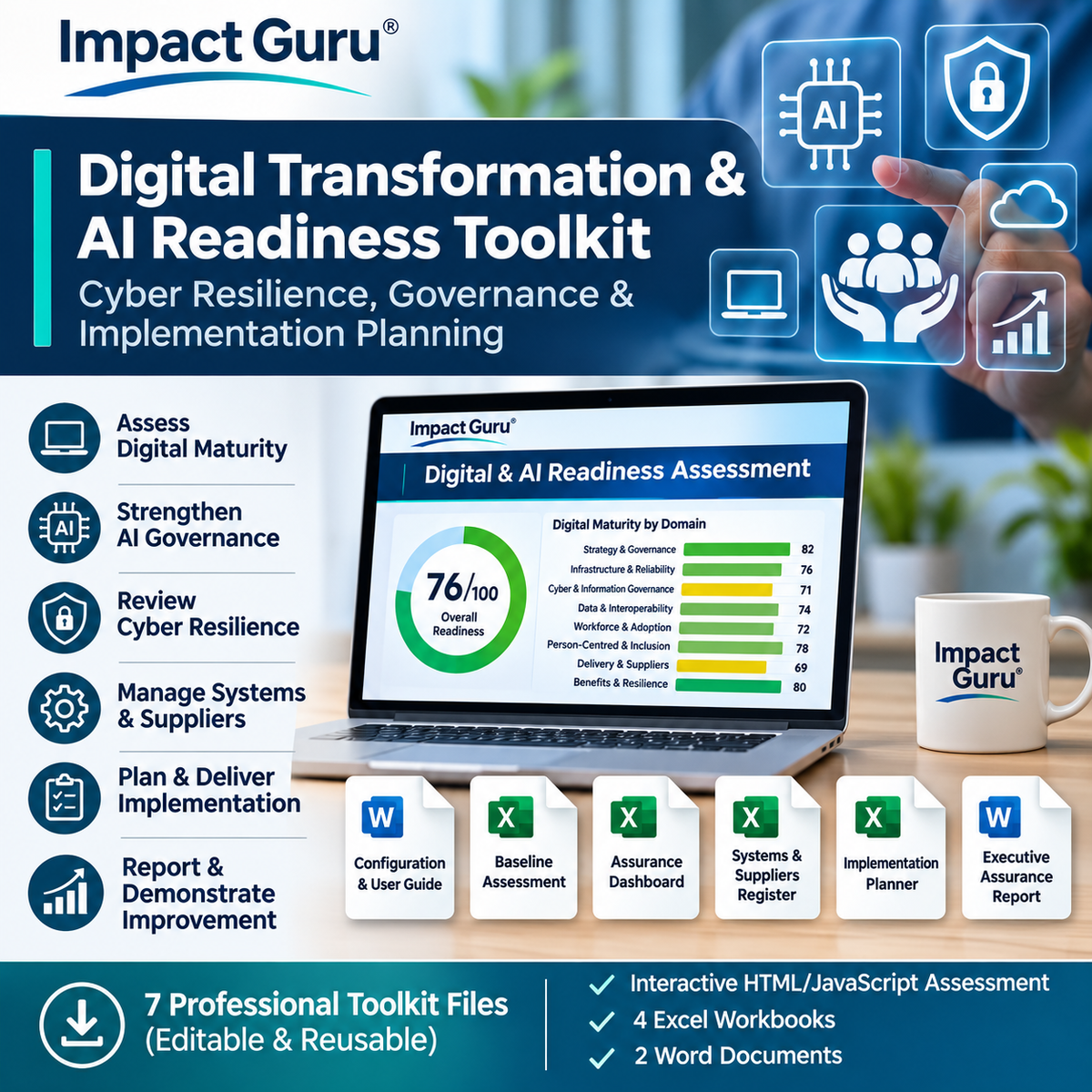
Combining an interactive HTML/JavaScript assessment with professionally formatted Excel workbooks and editable Word documents, the toolkit supports digital maturity assessment, AI governance, cyber and supplier assurance, leadership reporting and ongoing programme management.
It is designed as a reusable professional resource rather than a one-off assessment, helping organisations move from initial readiness evaluation to documented assurance, prioritised investment, accountable implementation and measurable improvement.
What Can the Toolkit Help You Achieve?
The toolkit provides a connected framework for understanding your organisation's current digital capabilities and establishing the controls needed to manage technology-related change.
- Assess digital maturity: Evaluate organisational readiness across eight domains covering leadership, infrastructure, cyber security, data, workforce capability, accessibility, implementation and resilience.
- Identify capability gaps: Highlight weaknesses requiring further investigation, investment or management attention.
- Strengthen AI governance: Consider approval responsibilities, human oversight, privacy, accuracy, bias, transparency and appropriate use of AI-enabled systems.
- Review cyber resilience: Identify critical concerns involving access controls, information security, incident management, recovery arrangements and system dependencies.
- Evaluate technology suppliers: Record systems, supplier responsibilities, criticality, assurance information and continuity risks.
- Improve workforce readiness: Consider staff confidence, training, practical competency, digital adoption and the management of change.
- Protect person-centred practice: Examine accessibility, consent, digital inclusion and whether technology supports meaningful outcomes for people receiving care.
- Prioritise implementation: Translate assessment findings into accountable actions, deadlines, resource considerations and a structured 30/60/90-day programme.
- Strengthen leadership oversight: Present maturity findings, unresolved risks, investment requirements and decisions through structured dashboards and executive reporting.
- Monitor improvement: Repeat assessments and review whether implemented changes have strengthened organisational capability and reduced identified risks.
The emphasis is on connecting digital ambition, professional judgement, governance, cyber resilience, workforce capability and demonstrable operational improvement.
What's Included in Your Download?
Version 1.0 is supplied as a single downloadable ZIP archive containing seven professional toolkit files.
The package includes:
- One comprehensive Configuration & User Guide in Microsoft Word format.
- One interactive HTML/JavaScript Digital & AI Readiness Assessment.
- Four professionally formatted, editable Microsoft Excel workbooks.
- One editable Executive Digital Readiness & Assurance Report in Microsoft Word format.
The components are designed to support a connected assessment and management workflow. The interactive assessment provides an accessible starting point, while the Excel and Word resources support more detailed assurance, tracking and reporting.
1. Configuration & User Guide
A professionally formatted, editable guide explaining the toolkit's purpose, assessment approach, scoring methodology, configuration options and recommended sequence of use.
The guide supports interpretation of maturity findings, use of the accompanying workbooks, evidence confidence, critical risk considerations and preparation of leadership reports.
It also explains important limitations, including the distinction between an internal readiness assessment and independent verification of legal, regulatory or cyber security compliance.
2. Interactive Digital & AI Readiness Assessment
An interactive HTML/JavaScript assessment that can be opened locally in a compatible desktop web browser without requiring a separate online account.
The assessment includes 32 structured questions across eight digital maturity domains, supported by an additional focus on AI governance and critical assurance concerns.
Key capabilities include:
- Structured digital maturity assessment.
- Consistent five-level maturity scoring.
- Domain-level and overall readiness indicators.
- Visual presentation of assessment findings.
- Identification of priority development areas.
- AI governance and cyber assurance prompts.
- CSV export for further analysis.
- Printable assessment reporting.
The assessment is intended to support informed management review. Its outputs are indicative and should be validated against relevant organisational evidence.
3. Digital Readiness Baseline Assessment
A self-configurable Microsoft Excel assessment workbook for documenting digital capability across the eight maturity domains.
Structured assessment tables, scoring fields and automated calculations help users identify strengths, weaknesses and areas requiring further evidence or improvement.
The workbook supports repeatable assessments and comparison of organisational capability over time, subject to consistent scoring and evidence review.
4. Digital, AI & Cyber Assurance Dashboard
A professionally formatted Excel dashboard for consolidating digital maturity findings and presenting important governance and assurance indicators.
The dashboard supports leadership review of domain performance, priority risks, AI governance readiness and cyber assurance concerns.
It is designed to help managers distinguish between overall maturity and critical exceptions that may require immediate escalation regardless of the aggregate assessment score.
Where information is transferred between separate workbook files, users should follow the Configuration & User Guide and verify that the reported figures match their completed assessment.
5. Systems, Suppliers & Cyber Assurance Register
A configurable Excel register for documenting the digital systems and external technology dependencies used by an organisation.
Structured tables support the recording and review of:
- Digital systems and their operational purpose.
- Supplier responsibilities and dependencies.
- System criticality and service continuity considerations.
- Cyber security and access-control assurance.
- Information governance and data protection concerns.
- Outstanding weaknesses and required management actions.
- Responsible owners and review arrangements.
The register supports more systematic oversight of technology-related dependencies and helps identify where further supplier due diligence or technical assurance may be required.
6. Digital Transformation Implementation Planner
A structured Excel planning workbook for translating readiness findings into practical improvement and transformation activity.
Professionally formatted action tables support prioritisation, ownership, deadlines, status monitoring and consideration of investment and implementation dependencies.
The planner also supports a 30/60/90-day approach to early improvement, helping organisations distinguish urgent control weaknesses from longer-term transformation priorities.
It can be adapted for individual services, multi-site providers, operational teams or organisation-wide digital programmes.
7. Executive Digital Readiness & Assurance Report
A professionally formatted, editable Microsoft Word report designed for directors, senior leadership teams, boards, governance meetings and other internal assurance arrangements.
The report includes structured tables and management decision fields covering:
- Executive decisions and headline readiness indicators.
- Assessment scope, evidence confidence and limitations.
- Findings across the eight digital maturity domains.
- Critical cyber, privacy and operational exceptions.
- AI governance and deployment approval considerations.
- 30/60/90-day implementation priorities.
- Management decisions, conditions and sign-off.
The report is designed to help organisations communicate their assurance position clearly while documenting the decisions and responsibilities needed to progress improvement.
Eight Digital Readiness Assessment Domains
The toolkit's core maturity framework examines eight connected dimensions of digital capability.
- Digital Strategy, Leadership and Governance: Organisational direction, accountability, digital decision-making and oversight.
- Technology Infrastructure and System Reliability: Devices, connectivity, system availability, monitoring and capacity.
- Cyber Security, Privacy and Information Governance: Information protection, access management, risk assessment, incident response and recovery.
- Digital Care Systems, Data Quality and Interoperability: Digital records, data reliability, authorised access and information exchange.
- Workforce Capability, Confidence and Change Readiness: Digital skills, practical competency, staff engagement and adoption.
- Person-Centred Technology, Accessibility and Digital Inclusion: Accessibility, consent, individual choice, privacy and meaningful outcomes.
- Implementation, Supplier and Programme Management: Procurement, supplier assurance, testing, deployment and programme control.
- Benefits Realisation, Assurance and Digital Resilience: Measurement of benefits, operational continuity, lessons learned and ongoing improvement.
These domains provide a structured picture of organisational maturity. They should be interpreted alongside specific AI governance considerations and any critical cyber, privacy, safeguarding or operational risks.
A strong overall maturity score must not be used to dismiss an unresolved critical control weakness.
AI Governance: From Experimentation to Accountable Deployment
Artificial intelligence is increasingly relevant to administrative processes, information analysis, workforce planning, quality monitoring and operational decision support.
However, organisations need to distinguish between the potential benefits of AI and the governance arrangements required for its appropriate use.
The toolkit supports structured consideration of:
- Whether the proposed AI use case has a clear purpose and accountable owner.
- Whether privacy, lawful processing and data protection implications have been considered.
- Whether appropriate human review and oversight are maintained.
- Whether outputs have been tested for accuracy, reliability and potential bias.
- Whether supplier arrangements and data handling have been examined.
- Whether staff understand the system's limitations and escalation procedures.
- Whether approval, monitoring and review responsibilities are documented.
AI readiness should not be interpreted as automatic permission to deploy a system. Where significant concerns remain unresolved, further review or specialist advice may be necessary before implementation.
Who Is This Toolkit For?
The Digital Transformation & AI Readiness Toolkit is designed for professionals responsible for digital strategy, service improvement, governance, operational assurance and technology-related change.
- Adult social care provider directors and senior leaders.
- Registered Managers and operational managers.
- Quality assurance and compliance leads.
- Digital transformation and improvement managers.
- Information governance and cyber security leads.
- Workforce development and training managers.
- Commissioning and contract management professionals.
- Independent health and social care consultants.
It may be particularly relevant to organisations delivering homecare, supported living, learning disability and autism support, mental health services, residential care, complex care and community-based support.
Its principles may also be adapted by other health, public service and voluntary sector organisations, subject to their specific legal, regulatory and operational requirements.
How the Toolkit Works
Step 1 — Establish Your Baseline
Begin with the Configuration & User Guide and complete the interactive assessment or detailed Excel baseline assessment.
Review the eight maturity domains using available evidence and informed professional judgement.
Step 2 — Review Maturity and Evidence Confidence
Examine the overall findings and individual domain results. Identify where evidence is incomplete, assumptions require validation or capability gaps affect organisational readiness.
Step 3 — Identify Critical Risks
Consider cyber security, privacy, unsupported technology, business continuity, supplier dependencies and AI governance concerns separately from the overall maturity score.
Escalate material concerns through appropriate organisational procedures.
Step 4 — Review Systems and Suppliers
Use the Systems, Suppliers & Cyber Assurance Register to document important digital dependencies and identify where additional assurance or management action is required.
Step 5 — Prioritise Transformation Activity
Use the Implementation Planner to establish achievable priorities, accountable owners, target dates, resource considerations and appropriate measures of success.
Step 6 — Prepare Executive Assurance Reporting
Transfer validated assessment findings, critical exceptions and agreed actions into the Executive Digital Readiness & Assurance Report.
Document management decisions, approval conditions and review responsibilities.
Step 7 — Monitor Delivery and Reassess
Review implementation progress, evaluate whether changes have produced the intended benefits and repeat the readiness assessment at appropriate intervals.
From Digital Assessment to Sustainable Transformation
A common weakness in digital transformation programmes is the gap between identifying an opportunity and demonstrating that implementation has improved services.
An organisation may purchase a new digital care system, deliver staff training and complete a rollout. However, meaningful assurance requires further questions.
Has the technology improved information quality? Are staff using it confidently and consistently? Have duplication and administrative burdens reduced? Are privacy and security controls effective? Can the organisation continue operating if the system becomes unavailable? Have outcomes improved for people receiving support?
The toolkit encourages a connected improvement process:
Readiness assessment → Evidence validation → Critical risk review → Supplier assurance → Prioritised implementation → Leadership approval → Benefits monitoring → Reassessment.
This approach helps organisations treat digital transformation as a managed programme of operational improvement rather than simply a technology purchasing exercise.
Designed for Practical, Repeated Use
Unlike a single online readiness report, the Digital Transformation & AI Readiness Toolkit provides reusable working resources for assessment, governance, planning and management review.
The HTML assessment operates locally in a compatible browser. The Excel workbooks and Word documents can be edited and adapted to organisational requirements.
Professionally formatted tables, assessment fields, visual indicators and structured reporting sections support practical use by managers and leadership teams.
The toolkit does not require a separate Impact Guru application subscription or ongoing online account for its core offline functions.
Important: Users remain responsible for protecting working files, maintaining backups, controlling access and avoiding unnecessary inclusion of confidential or identifiable personal information. The toolkit is not a secure hosted evidence repository or specialist cyber security platform.
Free Assessment or Professional Toolkit?
Impact Guru also provides a free online Digital Transformation Readiness Assessment, designed to help organisations undertake an initial review of their digital strategy, cyber resilience and technology capability.
The downloadable Digital Transformation & AI Readiness Toolkit serves a broader purpose.
It provides a reusable assessment environment, detailed Excel workbooks, AI and cyber assurance considerations, supplier oversight, implementation planning and structured executive reporting.
The free assessment helps organisations understand their starting position. The professional toolkit provides the additional resources needed to investigate findings, manage priorities, document decisions and monitor improvement.
Download Format and Technical Requirements
- Delivery: Digital download supplied as a ZIP archive.
- Version: 1.0.
- Package: Seven files.
- Interactive assessment: HTML/JavaScript file for use in a compatible modern desktop browser.
- Excel workbooks: Four editable XLSX files.
- Word documents: Two editable DOCX files.
- Internet connection: Not required for core offline assessment and document editing.
- Account: No separate Impact Guru application account required.
- Recommended environment: Desktop or laptop computer with compatible Microsoft Office applications and a modern web browser.
- Updates: The toolkit does not automatically retrieve new regulatory guidance, cyber security standards or AI governance requirements.
This is a downloadable professional toolkit, not a hosted software subscription, specialist technical audit, cyber security certification or bespoke consultancy engagement.
About Impact Guru
Impact Guru provides specialist bid strategy, tender writing, quality assurance and professional intelligence resources for organisations operating across adult social care and related public service sectors.
The Digital Transformation & AI Readiness Toolkit reflects a practical approach to technology governance, organisational capability, cyber resilience, professional accountability and evidence-led improvement.
Explore further guidance through the Impact Guru Digital Transformation Knowledge Hub.
Important Professional, Regulatory and Technical Disclaimer
The Digital Transformation & AI Readiness Toolkit is an independent professional management resource developed by Impact Guru Ltd.
It does not provide certification of cyber security, regulatory compliance, information governance compliance, AI safety or organisational digital maturity.
Assessment scores and dashboard indicators are internal management measures. They depend on the completeness, accuracy and professional interpretation of information entered by users and should not be treated as independently verified findings.
The toolkit does not replace specialist cyber security assessment, data protection advice, safeguarding procedures, legal advice, professional judgement or independent technical assurance.
Users must consider the legislation, regulatory expectations, sector guidance and contractual requirements applicable to their own services. Relevant requirements may change over time.
The toolkit does not automatically update when standards, legislation or regulatory guidance change.
Digital product: Please review the product description, technical requirements and applicable digital-product terms before purchasing.
Share