Impact Guru
Commissioner Evidence & Contract Assurance Toolkit | Contract Monitoring, KPI Reporting & Evidence Verification
Commissioner Evidence & Contract Assurance Toolkit | Contract Monitoring, KPI Reporting & Evidence Verification
Couldn't load pickup availability
Commissioner Evidence & Contract Assurance Toolkit — Version 1.0
A comprehensive, self-configurable commissioner evidence, contract monitoring, performance assurance and reporting toolkit for adult social care and community service providers in England.
Effective commissioner assurance requires much more than submitting performance figures, describing service activity or presenting positive case studies. Providers must be able to demonstrate that contractual requirements are understood, performance information is reliable, evidence claims are substantiated and service delivery is producing meaningful outcomes for people.
Commissioners may require evidence relating to safeguarding, quality, workforce capability, outcomes, service continuity, value for money, partnership working, governance and improvement. Evidence needs to be current, traceable, consistent and relevant to the specific contract or procurement opportunity.
Many organisations collect significant amounts of operational information but struggle to turn that information into a coherent commissioner-facing assurance position. Quality audits may sit separately from performance reports, workforce information may not demonstrate practical competence, and case studies may describe activity without establishing measurable outcomes.
Similarly, strong contract performance can be difficult to demonstrate when reporting definitions are inconsistent, evidence sources are unclear or improvements are not linked to documented management decisions.
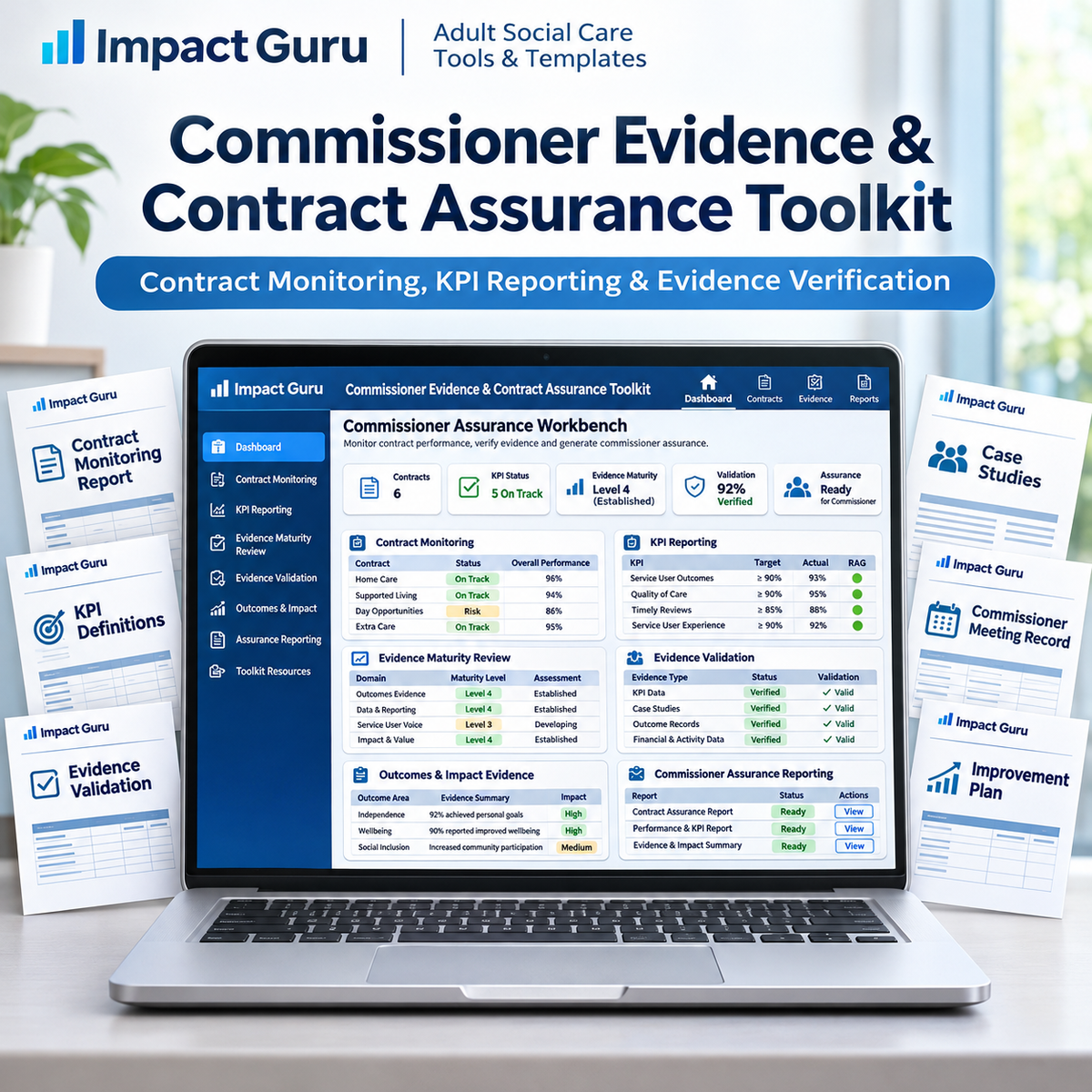
The Impact Guru Commissioner Evidence & Contract Assurance Toolkit — Version 1.0 provides a connected set of professional resources for assessing evidence maturity, mapping contract requirements, verifying claims, monitoring KPIs, preparing commissioner reports, documenting challenge and implementing structured improvement.
The toolkit combines an interactive HTML/JavaScript commissioner assurance workbench, a 12-worksheet Microsoft Excel evidence and contract assurance workbook, and nine professionally formatted Microsoft Word documents.
Together, these resources help organisations move from fragmented evidence collection and reactive contract reporting towards structured evidence management, transparent performance assurance, credible commissioner engagement and demonstrable service improvement.
The toolkit is designed for repeated use across contract monitoring, commissioner quality reviews, tender preparation, contract mobilisation, provider due diligence, service improvement programmes and internal governance reporting.
What Can the Toolkit Help You Achieve?
The toolkit provides a structured approach to collecting, validating, presenting and maintaining evidence that supports commissioner confidence in service delivery and contractual performance.
- Assess commissioner evidence maturity: Review the strength, availability and reliability of evidence across 11 important service and contract assurance areas.
- Map contractual requirements: Establish clearer connections between contract specifications, reporting obligations, performance measures and supporting evidence.
- Strengthen evidence credibility: Record evidence sources, document references, reporting periods, validation arrangements and limitations.
- Improve contract performance monitoring: Maintain structured records of agreed KPIs, reporting expectations, performance concerns and corrective actions.
- Verify commissioner-facing claims: Distinguish between unsupported assertions, operational activity, documented outputs and evidence of measurable impact.
- Develop stronger outcome evidence: Prepare structured case studies showing baseline needs, support delivered, measurable progress and outcomes achieved.
- Identify evidence gaps: Highlight missing, fragmented or unverified information that could weaken contract reporting, tender submissions or commissioner assurance.
- Strengthen governance oversight: Connect performance information, risk registers, quality reviews, improvement actions and management decisions.
- Prepare professional commissioner reports: Present performance, outcomes, exceptions, evidence limitations and improvement activity in a consistent format.
- Improve KPI definitions: Document reporting measures, calculation methods, thresholds, data ownership and information-quality requirements.
- Support commissioner meetings: Record questions, challenge, management responses, decisions, action owners and follow-up commitments.
- Improve tender readiness: Organise existing evidence against specification requirements, evaluation questions and supporting assurance expectations.
- Strengthen risk and exception reporting: Identify performance concerns, overdue actions, weak controls and matters requiring contractual or statutory escalation.
- Implement structured improvement: Develop a 30/60/90-day programme for strengthening evidence quality, reporting arrangements and contract assurance.
- Support repeated assurance reviews: Maintain records that can be updated across monitoring periods, contract meetings and future procurement opportunities.
The emphasis is on connecting commissioner requirements, operational performance, evidence verification, governance accountability, outcomes for people and continuous improvement.
What's Included in Your Download?
Version 1.0 is supplied as a single downloadable ZIP archive containing 11 professional toolkit files.
The package includes:
- Configuration & User Guide — Microsoft Word.
- Interactive Commissioner Evidence & Contract Assurance Workbench — offline HTML/JavaScript.
- Commissioner Evidence & Contract Assurance Workbook — Microsoft Excel.
- Commissioner Evidence Governance Framework — Microsoft Word.
- Contract Monitoring & Commissioner Report — Microsoft Word.
- Evidence Validation & Claims Protocol — Microsoft Word.
- Outcomes & Impact Case Study Pack — Microsoft Word.
- KPI Definitions & Threshold Handbook — Microsoft Word.
- Commissioner Meeting & Challenge Record — Microsoft Word.
- Tender & Contract Requirement Mapping — Microsoft Word.
- 30/60/90-Day Evidence Improvement Plan — Microsoft Word.
The files are numbered in their recommended order of use. Each component supports a different part of the commissioner evidence and contract assurance process.
1. Configuration & User Guide
A professionally formatted Microsoft Word guide explaining the toolkit's purpose, structure, configuration requirements, assessment methodology, recommended operating arrangements and practical limitations.
The guide supports users in understanding how the interactive workbench, Excel workbook and supporting Word documents fit together.
It helps organisations consider:
- How to define the contract, commissioner and service scope of an assurance review.
- How to interpret the evidence maturity and confidence assessment.
- How to distinguish contract-critical evidence from routine supporting information.
- How to establish evidence ownership and reporting responsibilities.
- How to record the source and reliability of performance claims.
- How to organise reporting periods, evidence references and contract requirements.
- How to use the Excel workbook for ongoing contract monitoring and assurance.
- How to maintain commissioner meeting records and action logs.
- How to prepare outcome evidence and commissioner reports.
- How to manage evidence gaps and improvement priorities.
- How to protect confidential organisational and personal information.
- How to establish a repeatable contract assurance review cycle.
The Configuration & User Guide is File 01 and should be read before using the remaining toolkit components.
2. Interactive Commissioner Evidence & Contract Assurance Workbench
An interactive HTML/JavaScript workbench that can be opened locally in a compatible modern desktop web browser without requiring a separate online account.
The workbench provides a structured environment for reviewing the evidence available across 11 commissioner assurance areas.
Users can configure the assessment to reflect their organisation, contract or procurement opportunity, service model, reporting period and current assurance priorities.
Key capabilities include:
- Assessment across 11 commissioner evidence domains.
- Five evidence maturity positions, from missing to assured.
- Separate evidence confidence ratings.
- Contractual and safety criticality considerations.
- Recording of evidence sources and document references.
- Identification of missing or fragmented evidence.
- Identification of critical-priority validation concerns.
- Area-level commissioner challenge prompts.
- Indicative overall evidence maturity scoring.
- Structured commissioner assurance findings.
- Recommendations for evidence improvement and follow-up.
- Printable assessment reporting, which can be saved as a PDF through the browser.
- CSV export for further analysis and record transfer.
- JSON export and import for preserving and reopening assessments.
The workbench helps organisations identify where they have reasonable evidence foundations and where further validation, investigation or corrective action may be required.
Important: Evidence maturity ratings are internal management assessments. They do not independently verify contractual compliance, establish that commissioner requirements have been met or certify the accuracy of submitted evidence.
Actual contract obligations, mandatory reporting arrangements and source documents must always be checked separately.
3. Commissioner Evidence & Contract Assurance Workbook
A professionally formatted, editable Microsoft Excel workbook containing 12 worksheets for ongoing evidence management, contract assurance, performance monitoring and reporting.
The workbook provides structured recording arrangements for the different elements of commissioner assurance.
Its scope includes:
- Contract and assessment configuration.
- Commissioner evidence area review.
- Contract requirements and obligations.
- Evidence sources and validation records.
- KPI and performance monitoring.
- Commissioner-facing claims assurance.
- Outcomes and impact evidence.
- Risks, exceptions and escalation.
- Improvement actions and responsibilities.
- Commissioner meetings and decisions.
- Evidence review and reporting information.
- Executive assurance and dashboard information.
The workbook enables organisations to maintain clearer links between contractual requirements, operational information, performance reporting and management action.
It supports repeated review across reporting periods, allowing users to refresh evidence, consider changes in performance and monitor outstanding concerns.
All Excel recording tables are professionally formatted with visible borders, structured headings and clear fields to support completion and management review.
The workbook complements the interactive workbench by providing more detailed registers and working records for ongoing contract assurance.
Important: Users must configure their own contractual KPIs, reporting definitions, performance thresholds and evidence requirements. No illustrative measure should be treated as a universal commissioner or CQC standard.
4. Commissioner Evidence Governance Framework
An editable Microsoft Word resource supporting the establishment or review of organisational arrangements for commissioner evidence management and contractual assurance.
The framework helps providers consider:
- Ownership of commissioner and contract assurance responsibilities.
- Allocation of evidence collection and verification duties.
- Management oversight and approval arrangements.
- Contract reporting responsibilities.
- Quality and performance review arrangements.
- Evidence ownership and document control.
- Risk reporting and escalation routes.
- Improvement action ownership and follow-up.
- Governance review and commissioner reporting cycles.
It is particularly useful where evidence is collected by different operational teams but must be consolidated into a consistent, reliable commissioner-facing report.
The framework can be adapted to existing quality assurance, contract management and corporate governance arrangements.
5. Contract Monitoring & Commissioner Report
A professionally formatted, editable Microsoft Word reporting template for preparing structured contract monitoring and commissioner assurance reports.
The document supports the presentation of:
- Contract and reporting-period information.
- Executive performance and assurance summaries.
- Key performance indicators and delivery trends.
- Service quality and safeguarding information.
- Workforce and service continuity assurance.
- Outcomes achieved and evidence of impact.
- Significant risks, exceptions and emerging concerns.
- Evidence quality and reporting limitations.
- Completed improvement actions and outstanding priorities.
- Governance oversight and management responses.
- Commissioner decisions and matters requiring follow-up.
The report is designed to help providers present a coherent explanation of what is happening within the contract, how effectively requirements are being met and what action is being taken where improvement is needed.
It supports transparent reporting rather than relying solely on positive statistics or lists of completed activities.
6. Evidence Validation & Claims Protocol
An editable Microsoft Word resource supporting consistent verification of information before it is used in commissioner reports, tender submissions, assurance meetings or other external communications.
The protocol helps organisations examine whether evidence claims are:
- Relevant to the specific requirement or question.
- Based on identifiable source information.
- Current and appropriate to the reporting period.
- Accurately calculated and consistently defined.
- Supported by suitable documentary or operational evidence.
- Clear about limitations, qualifications and assumptions.
- Reviewed and authorised by an accountable person.
- Presented without unsupported conclusions or misleading comparisons.
For example, a provider may state that its service has improved people's independence. The protocol encourages users to consider how that conclusion is supported by baseline information, individual goals, review findings, measurable progress and reliable evidence of change.
Similarly, claims about workforce continuity, reduced incidents, training competence or contract performance should be linked to appropriate source records and reporting definitions.
The objective is to make commissioner-facing evidence more credible, reproducible and defensible under scrutiny.
7. Outcomes & Impact Case Study Pack
A professionally formatted Microsoft Word resource for preparing stronger evidence of personal outcomes and service impact.
Case studies can provide powerful supporting evidence, but only when they explain what changed and how that change can reasonably be attributed to the service provided.
The pack supports a structured approach to documenting:
- The person's starting situation or baseline needs.
- The outcomes they wanted to achieve.
- The support or intervention delivered.
- The person's involvement, choice and preferences.
- Progress made during the reporting period.
- Measurable or observable changes.
- Supporting records and evidence sources.
- Any limitations or factors affecting interpretation.
- Learning and future support requirements.
The resource can help providers prepare anonymised case studies for tenders, contract reviews, service improvement meetings and commissioner assurance discussions.
It supports the distinction between activity, outputs, outcomes and wider impact, helping organisations avoid presenting care activity alone as proof of meaningful improvement.
Information must be appropriately anonymised or otherwise lawfully handled, with relevant confidentiality and consent requirements considered before external use.
8. KPI Definitions & Contract Threshold Handbook
An editable Microsoft Word resource for strengthening the consistency and reliability of contract performance reporting.
Different organisations and commissioners may use similar KPI labels while applying different calculation methods, reporting periods, denominators or performance expectations.
The handbook supports organisations in documenting:
- KPI names and intended purposes.
- Contractual reporting requirements.
- Numerator and denominator definitions.
- Calculation methods and reporting periods.
- Data sources and accountable owners.
- Performance targets and tolerance thresholds.
- Evidence validation and data-quality checks.
- Exception reporting and escalation expectations.
- Actions required when performance falls below agreed standards.
- Review and change-control arrangements.
For example, training compliance, missed visits, staff turnover, outcome achievement and action completion may all require precise definitions before results can be compared meaningfully.
The handbook supports more reliable reporting by encouraging providers to agree what each measure actually represents.
Contract-specific thresholds must always take precedence over general management guidance or illustrative examples.
9. Commissioner Meeting & Challenge Record
A professionally formatted Microsoft Word resource for recording commissioner discussions, assurance questions, management responses and agreed follow-up actions.
It helps providers maintain structured records of:
- Meeting purpose, attendees and reporting period.
- Principal performance and quality matters discussed.
- Commissioner questions and requests for additional evidence.
- Management explanations and supporting information.
- Disputed or unresolved performance interpretations.
- Significant risks and matters requiring escalation.
- Agreed decisions and improvement actions.
- Named owners, deadlines and review arrangements.
- Evidence of completion and subsequent follow-up.
The document is intended to support continuity between monitoring meetings and strengthen the audit trail of commissioner engagement.
It also helps providers distinguish between actions that have been agreed, information that remains outstanding and issues requiring a formal decision.
Structured recording tables and interactive Word checkbox controls support practical meeting preparation and follow-through in compatible Microsoft Word applications.
10. Tender & Contract Requirement Mapping
An editable Microsoft Word resource for connecting commissioner requirements with the provider's delivery approach and available evidence.
The document supports the structured mapping of:
- Tender questions and evaluation requirements.
- Contract and service specification obligations.
- Required operational policies and procedures.
- Evidence documents and performance sources.
- Existing service delivery arrangements.
- Relevant case studies and measurable outcomes.
- Evidence gaps and additional validation needs.
- Responsible contributors and reviewers.
- Outstanding actions and submission readiness.
It is relevant both to competitive tendering and to ongoing contract management.
For tenders, it helps organisations identify whether they have credible evidence to support method statements and proposed delivery arrangements.
For live contracts, it can support the review of whether important obligations have been translated into operational controls, reporting arrangements and documented assurance.
The resource does not automatically interpret tender instructions or establish procurement compliance. Users must check each opportunity's requirements and evaluation criteria.
11. 30/60/90-Day Evidence Improvement Plan
An editable Microsoft Word implementation resource supporting a staged approach to strengthening commissioner evidence and contract assurance.
The plan is organised into three improvement periods.
First 30 Days — Establish, Validate and Prioritise
- Confirm the review scope, contract obligations and reporting requirements.
- Identify evidence owners and accountable managers.
- Review existing performance data and source documents.
- Identify missing, fragmented or unverified evidence.
- Prioritise serious contractual, safety or quality assurance gaps.
- Agree immediate actions, deadlines and escalation requirements.
Days 31–60 — Strengthen Evidence and Reporting
- Improve KPI definitions and data-quality arrangements.
- Develop stronger outcome case studies and impact evidence.
- Validate significant commissioner-facing claims.
- Update contract reporting templates and governance records.
- Address repeated performance exceptions and missing assurance.
- Prepare a more consistent commissioner evidence pack.
Days 61–90 — Test, Report and Embed Improvement
- Review the effectiveness of completed evidence improvements.
- Recheck previously weak or unverified information.
- Test whether reporting controls are working consistently.
- Evaluate improvements in the quality of commissioner reports.
- Challenge overdue actions and unresolved evidence gaps.
- Agree the next monitoring cycle and longer-term assurance priorities.
The plan helps organisations move beyond identifying documentation gaps towards improving the reliability of evidence, accountability for reporting and the quality of commissioner engagement.
The 11 Commissioner Evidence & Contract Assurance Areas
The professional toolkit builds on the 11 evidence areas established within the free Impact Guru Commissioner Evidence Builder.
- Quality and Safety: Quality audits, safety information, incident themes, improvement actions, management oversight and evidence of safer practice.
- Safeguarding and Risk Management: Safeguarding arrangements, risk assessments, escalation, multi-agency working, thematic learning and evidence of risk reduction.
- Workforce Capacity and Competence: Staffing sufficiency, recruitment, retention, supervision, training, practical competence and workforce continuity.
- Outcomes and Impact: Personal goals, progress, independence, wellbeing, quality of life, measurable changes and case study evidence.
- Governance and Provider Assurance: Senior oversight, risk registers, management challenge, audits, action tracking and organisational accountability.
- Service Delivery Model: Referral pathways, assessment, care planning, delivery arrangements, changing needs, contingencies and operational effectiveness.
- Mobilisation and Implementation: Mobilisation milestones, readiness checks, workforce arrangements, systems preparation, dependencies and early service assurance.
- Partnership and System Working: Multi-agency coordination, shared working arrangements, information exchange, professional escalation and partnership outcomes.
- Value for Money and Sustainability: Efficiency, prevention, resource use, service continuity, demand pressures and evidence of value beyond headline price.
- Digital Records and Data: Source data, digital records, audit trails, dashboard information, data completeness and information governance.
- Social Value and Added Value: Local commitments, community benefits, employment, skills development, partnership contributions and evidence of delivered social value.
These areas provide a broad commissioner assurance framework. Individual organisations should adapt the assessment to the services delivered, the actual contract specification and the information required by each commissioner.
Not every evidence area will be equally relevant to every contract. The interactive workbench allows users to identify areas outside the review scope rather than assigning artificial positive scores.
Understanding Commissioner Evidence Maturity
Evidence maturity is not simply a measure of how many documents an organisation holds.
A provider may maintain extensive policies, performance dashboards, audits and case studies without being able to demonstrate that the information is accurate, current, relevant and connected to contractual requirements.
The interactive workbench uses five evidence maturity positions:
- 0 — Missing: Required or relevant evidence has not been identified or is unavailable.
- 1 — Fragmented: Some information exists but is incomplete, inconsistent or difficult to verify.
- 2 — Defined: Evidence is organised and identifiable, although independent verification or application remains limited.
- 3 — Verified: Evidence has been checked against appropriate source information and supports the relevant assurance statement.
- 4 — Assured: Evidence is current, consistently maintained, appropriately reviewed and linked to meaningful assurance or improvement.
The workbench also considers evidence confidence and the importance of the relevant contractual or safety requirement.
This matters because an apparently mature evidence collection can still contain serious weaknesses where critical information has not been verified.
For example, an organisation may have strong general performance reporting but insufficient evidence of a specific safeguarding response, a mandatory contractual KPI or a required mobilisation milestone.
A high overall evidence maturity score must never be used to dismiss a significant contractual breach, safeguarding risk or unreliable performance claim.
From Evidence Collection to Credible Commissioner Assurance
One of the most common weaknesses in contract reporting is the gap between collecting information and demonstrating what that information means.
A provider may report high training compliance, completed audits, positive satisfaction results and strong activity levels.
However, commissioners may reasonably ask whether training has improved competence, whether audits identified and resolved weaknesses, whether satisfaction data is representative and whether recorded activity has produced better outcomes.
Effective commissioner assurance therefore requires more than presenting positive figures.
The toolkit encourages organisations to examine:
- What requirement or outcome is being evidenced?
- Which document or data source supports the claim?
- Is the information current and relevant to the reporting period?
- Have calculation methods and reporting definitions been checked?
- Are performance results consistent with incidents, audits, complaints and feedback?
- Is there evidence that identified weaknesses were addressed?
- Can reported outcomes be supported by meaningful baseline and review information?
- Have limitations or uncertainties been made clear?
- Who has reviewed and authorised the information?
- What additional assurance might a commissioner reasonably request?
The purpose of commissioner evidence is not merely to demonstrate that a service is active. It is to show that contractual responsibilities are understood, delivery is monitored, risks are addressed and meaningful outcomes can be evidenced.
Strengthening Contract Performance Monitoring
Contract monitoring is most effective when providers can explain performance against agreed requirements and identify concerns before they become persistent or significant failures.
This depends on clear KPI definitions, reliable data sources, appropriate reporting periods and accountable management review.
The toolkit supports a more disciplined approach by connecting:
- Contract obligations and service specifications.
- Agreed performance measures and reporting requirements.
- Data definitions, calculation methods and evidence sources.
- Performance exceptions and emerging delivery risks.
- Operational and management responses.
- Action owners, deadlines and follow-up evidence.
- Commissioner challenge and contractual decisions.
- Continuous improvement and outcome evidence.
For example, a domiciliary care contract may require reporting on missed or late visits, continuity of carers, complaints, safeguarding concerns and service-user outcomes.
Each measure must be defined and calculated in accordance with the contract and applicable reporting requirements.
The toolkit helps organisations maintain a structured evidence trail showing where the figures came from, what they mean and how management has responded to identified concerns.
Evidence Validation and Avoiding Unsupported Claims
Commissioner-facing reporting can be weakened by claims that sound persuasive but are not supported by sufficiently reliable evidence.
Statements such as "our service consistently delivers excellent outcomes", "our workforce is highly competent" or "our model reduces pressure on hospitals" may require more detailed substantiation than is initially available.
The toolkit's Evidence Validation & Claims Protocol supports a systematic review of those statements before external use.
For example:
- A workforce competence claim should be supported by relevant practical competency evidence, not only attendance at training.
- An outcome improvement claim should refer to measurable or observable change, not solely the number of support hours delivered.
- A claim about reduced hospital admissions should distinguish demonstrated evidence from assumptions about prevention or avoided costs.
- A quality improvement claim should connect identified weaknesses, corrective actions, follow-up checks and evidence of sustained change.
- A social value claim should distinguish planned commitments from benefits that have actually been delivered and verified.
These distinctions are important in competitive tendering, contract monitoring, due diligence and quality assurance reviews.
Evidence should be proportionate, traceable and accurate. Strong commissioner confidence is built through credible claims, not exaggerated assertions.
Demonstrating Outcomes and Impact
Many commissioner reporting frameworks place importance on understanding what people have achieved through the support they receive.
However, activity and outcomes are not interchangeable.
For example, recording that a person received ten community support sessions demonstrates service activity. It does not, by itself, show whether those sessions improved confidence, independence, participation or quality of life.
Outcome evidence is stronger when it explains:
- The person's starting position.
- Their individual goals and preferences.
- The support provided and why it was appropriate.
- The changes observed or measured.
- How the person's own experience was considered.
- Which records support the reported improvement.
- Whether progress has been sustained.
- Any limitations in determining the contribution made by the service.
The Outcomes & Impact Case Study Pack supports this approach through editable evidence-recording structures.
It can help organisations produce more useful examples for commissioners while retaining appropriate safeguards around personal information, consent and confidentiality.
Using the Toolkit for Tender and Procurement Evidence
Commissioner evidence is relevant not only to existing contracts but also to future tendering and procurement opportunities.
Competitive tenders may require providers to demonstrate experience, delivery capability, workforce arrangements, quality assurance, safeguarding, outcomes, mobilisation readiness and evidence of continuous improvement.
Having a structured and regularly maintained evidence system can make it easier to identify suitable examples when an opportunity arises.
The toolkit's Tender & Contract Requirement Mapping resource supports a clear connection between:
- The specific question or service specification requirement.
- The proposed delivery approach.
- The provider's existing operational arrangements.
- Relevant documentary evidence.
- Performance data and measurable outcomes.
- Evidence gaps and additional work required.
- Internal review and sign-off responsibilities.
It can support better-prepared method statements, capability evidence, contract monitoring responses and internal assurance reviews.
Important: The toolkit is not an automated tender-writing application and does not guarantee evaluation scores or tender success. Each procurement must be assessed against its own instructions, requirements and evaluation methodology.
Who Is This Toolkit For?
The Commissioner Evidence & Contract Assurance Toolkit is designed for professionals responsible for contract delivery, commissioner relationships, organisational assurance, quality monitoring and evidence-led tendering.
- Adult social care provider directors and senior leaders.
- Registered Managers and service managers.
- Operations managers and regional managers.
- Contract managers and contract performance leads.
- Quality assurance and compliance managers.
- Business development and tender managers.
- Bid writers and bid strategy professionals.
- Governance and risk leads.
- Workforce and organisational development managers.
- Service mobilisation and transformation leads.
- Outcomes and impact measurement professionals.
- Commissioning and provider assurance teams.
- Independent health and social care consultants.
It is particularly relevant to organisations delivering homecare, supported living, learning disability and autism services, mental health support, reablement, hospital discharge services, older people's care, complex care and community-based services.
It can be adapted for individual services, multi-site providers, regional divisions and organisation-wide contract assurance arrangements.
Commissioner-side users must adapt the resources to their own governance, procurement, information management and contractual responsibilities.
How the Toolkit Works
Step 1 — Read the Configuration & User Guide
Begin with File 01 to understand the toolkit's components, assessment approach, evidence expectations and recommended workflow.
Step 2 — Define the Contract and Review Scope
Identify the commissioner, contract or tender opportunity, service model, reporting period, assessment purpose and relevant contractual requirements.
Step 3 — Complete the Interactive Evidence Assessment
Use the HTML/JavaScript workbench to review the 11 commissioner evidence areas, record maturity and confidence ratings, and identify supporting evidence.
Step 4 — Identify Evidence Gaps and Critical Priorities
Review missing information, weak validation, unreliable sources and any evidence concerns affecting important contractual or safety-related requirements.
Step 5 — Establish the Excel Assurance Records
Use the 12-worksheet workbook to record contract requirements, evidence references, KPI information, claims, outcomes, risks and improvement actions.
Step 6 — Verify Commissioner-Facing Claims
Use the Evidence Validation & Claims Protocol to check source information, reporting definitions, factual accuracy and the limitations of important claims.
Step 7 — Strengthen Outcomes and KPI Reporting
Use the Outcomes & Impact Case Study Pack and KPI Definitions Handbook to improve the quality of evidence relating to performance and changes achieved for people.
Step 8 — Prepare the Commissioner Assurance Report
Use the Contract Monitoring & Commissioner Report to present performance, outcomes, risks, exceptions, evidence limitations and improvement activity clearly.
Step 9 — Document Commissioner Challenge and Decisions
Use the Commissioner Meeting & Challenge Record to capture questions, management responses, actions, responsibilities and review arrangements.
Step 10 — Implement the 30/60/90-Day Improvement Plan
Agree priority evidence improvements, owners, deadlines, verification requirements and arrangements for testing progress.
Step 11 — Review and Repeat
Refresh evidence, update KPI performance, monitor outstanding actions and repeat the assurance review as new reporting periods and contractual requirements arise.
Designed for Practical, Repeated Use
The Commissioner Evidence & Contract Assurance Toolkit is designed as a reusable professional management resource rather than a one-off tender checklist or static commissioner report.
The interactive workbench operates locally in a compatible modern browser, while the Excel workbook and Microsoft Word documents can be edited to reflect organisational and contractual requirements.
Professionally formatted recording tables, visible borders, structured reporting sections, practical review prompts and interactive Word checkbox controls support repeated use.
Users can maintain evidence registers, reporting definitions and improvement records across different monitoring periods, services or contractual reviews.
The toolkit can be used alongside established contract management systems, governance processes, quality assurance arrangements and commissioner reporting templates.
The core offline tools do not require a separate Impact Guru application subscription or ongoing online account.
Important: The package is not a secure hosted evidence repository or care-record system. Users are responsible for protecting working files, controlling access, maintaining backups and ensuring that sensitive or identifiable information is handled appropriately.
Free Commissioner Evidence Builder or Professional Toolkit?
Impact Guru also provides a free online Commissioner Evidence Builder to help adult social care and community service providers identify suitable evidence for tenders, contract monitoring, quality reviews and commissioner assurance.
The free resource helps organisations consider their evidence maturity, existing strengths, known gaps, priority commissioner evidence areas and opportunities to improve reporting.
It provides suggested evidence sources, KPI ideas, commissioner challenge questions and an initial evidence-strengthening plan.
The downloadable Commissioner Evidence & Contract Assurance Toolkit serves a broader operational purpose.
It provides an interactive offline workbench with separate evidence maturity and confidence assessments, a 12-worksheet Excel assurance workbook, editable contract and evidence registers, claims validation arrangements, commissioner reporting templates, outcome case study documents, KPI definitions, meeting records and structured improvement planning.
These resources support implementation, evidence management, performance monitoring, source verification and repeated commissioner engagement.
The free Commissioner Evidence Builder helps organisations identify what evidence they need and where gaps may exist. The professional toolkit provides the working documents and assurance processes needed to organise, verify, monitor and present that evidence over time.
Both resources can be used independently. Purchase of the professional toolkit is optional.
Download Format and Technical Requirements
- Delivery: Digital download supplied as a ZIP archive.
- Version: 1.0.
- Package: 11 professional files.
- Microsoft Word: Nine editable DOCX documents.
- Microsoft Excel: One editable XLSX workbook containing 12 worksheets.
- Interactive application: One standalone offline HTML/JavaScript Commissioner Evidence & Contract Assurance Workbench.
- File 01: Configuration & User Guide — DOCX.
- File 02: Interactive Commissioner Evidence & Contract Assurance Workbench — HTML/JavaScript.
- File 03: Commissioner Evidence & Contract Assurance Workbook — XLSX.
- File 04: Commissioner Evidence Governance Framework — DOCX.
- File 05: Contract Monitoring & Commissioner Report — DOCX.
- File 06: Evidence Validation & Claims Protocol — DOCX.
- File 07: Outcomes & Impact Case Study Pack — DOCX.
- File 08: KPI Definitions & Threshold Handbook — DOCX.
- File 09: Commissioner Meeting & Challenge Record — DOCX.
- File 10: Tender & Contract Requirement Mapping — DOCX.
- File 11: 30/60/90-Day Evidence Improvement Plan — DOCX.
- Internet connection: Not required for core offline workbench and document-editing functions.
- Account: No separate Impact Guru application account required.
- Recommended environment: Desktop or laptop computer with compatible Microsoft Office applications and a modern web browser.
- Word checkboxes: Interactive checkbox content controls intended for compatible Microsoft Word desktop applications.
- Reporting: Printable workbench reports can be saved as PDF documents using the browser's print function.
- Data exports: The workbench supports local JSON and CSV exports, with JSON import for reopening saved assessments.
- Updates: The toolkit does not automatically retrieve new contract specifications, commissioner instructions, procurement rules or regulatory guidance.
This is a downloadable professional commissioner evidence and contract assurance toolkit, not a hosted contract management platform, independent compliance audit, commissioner-approved reporting system, automated procurement application or bespoke consultancy engagement.
About Impact Guru
Impact Guru provides specialist bid strategy, tender writing, quality assurance and professional intelligence resources for organisations operating across adult social care and related public service sectors.
The Commissioner Evidence & Contract Assurance Toolkit reflects an evidence-led approach to competitive tendering, contract performance, quality monitoring, organisational accountability and commissioner engagement.
It has been developed to help providers connect contractual expectations with credible operational evidence, measurable outcomes, reliable performance reporting and continuous improvement.
Explore further guidance through the Impact Guru Health & Social Care Bid Writing and Tendering Knowledge Hub.
Important Professional, Contractual, Procurement and Technical Disclaimer
The Commissioner Evidence & Contract Assurance Toolkit is an independent professional management resource developed by Impact Guru Ltd.
It provides structured evidence assessment, contract monitoring, KPI recording, claims verification, commissioner reporting and organisational improvement resources.
The toolkit does not independently verify contractual compliance, certify evidence accuracy, guarantee commissioner acceptance, establish procurement eligibility or demonstrate that all service requirements have been met.
Evidence maturity ratings and assurance findings are indicative management assessments. Their reliability depends on the accuracy of user-entered information, the quality of supporting records, the appropriateness of assessment judgements and effective review by responsible professionals.
A high assessment score does not demonstrate that mandatory contractual obligations have been fulfilled, performance targets have been achieved or safety and safeguarding risks have been adequately controlled.
The toolkit does not replace commissioner specifications, contract schedules, tender instructions, contractual reporting requirements, safeguarding duties, applicable procurement legislation, CQC requirements, professional judgement, independent audit or appropriate legal and specialist advice.
Users must verify the reporting definitions, evidence standards, submission instructions, contractual obligations and approval arrangements applicable to each individual contract or procurement opportunity.
Where serious safeguarding concerns, unsafe care, suspected contractual breaches, significant performance failures or other reportable matters are identified, established statutory, contractual, professional and emergency escalation procedures must be followed without delay.
All externally shared claims, KPI figures, case studies, financial information and outcome statements should be checked against relevant source records and appropriately authorised.
Organisations must ensure that any personal or confidential information is handled lawfully and securely in accordance with applicable UK GDPR, Data Protection Act 2018, confidentiality requirements and organisational information governance policies.
The toolkit does not automatically update when legislation, commissioner specifications, procurement rules, contract requirements or regulatory guidance change.
Digital product: Please review the product description, technical requirements and applicable digital-product terms before purchasing.
Share