Impact Guru
Supported Living Business Continuity Toolkit | Emergency Planning, Housing Resilience & Support Recovery
Supported Living Business Continuity Toolkit | Emergency Planning, Housing Resilience & Support Recovery
Couldn't load pickup availability
Supported Living Business Continuity & Emergency Resilience Toolkit — Version 1.0
A practical, self-configurable business continuity, emergency preparedness and support resilience toolkit for supported living providers in England.
Supported living services face distinctive continuity challenges. People may receive support in individual tenancies, shared houses, dispersed properties or specialist accommodation, with varying levels of daily assistance, overnight staffing, behavioural support, clinical involvement and housing-related responsibilities.
A disruption affecting staff, accommodation, utilities, transport, digital systems or a commissioned support arrangement can have serious consequences for people's safety, wellbeing, independence and rights.
Effective continuity planning must therefore consider more than organisational emergency procedures. Providers need to understand each person's support dependencies, the responsibilities of housing and care organisations, the availability of competent alternative staff and the circumstances in which temporary accommodation or alternative support may be necessary.
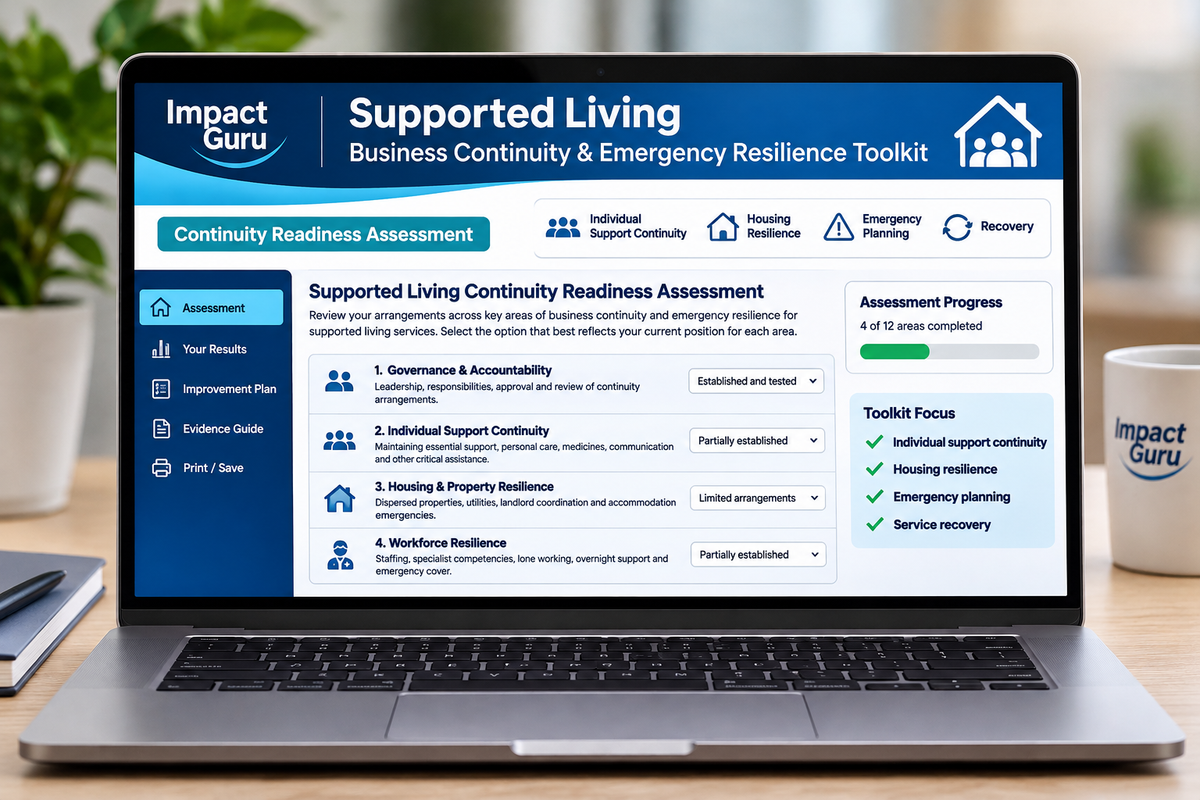
The Impact Guru Supported Living Business Continuity & Emergency Resilience Toolkit — Version 1.0 provides a connected set of professional resources for assessing preparedness, documenting service continuity arrangements, managing operational disruption and strengthening governance assurance.
Combining an interactive HTML/JavaScript readiness assessment with an editable Microsoft Excel risk and assurance workbook and professionally formatted Word documents, the toolkit supports person-centred continuity planning, coordinated emergency response, accountable decisions and structured recovery.
It is designed for repeated use across individual supported living services, dispersed housing arrangements, operational management teams and provider-wide governance processes.
What Can the Toolkit Help You Achieve?
The toolkit helps supported living providers establish practical arrangements for protecting essential support and responding to service disruption.
- Identify individual support dependencies: Consider personal care, medicines, communication, behavioural support, mobility, nutrition and other essential assistance.
- Strengthen person-centred continuity: Plan around people's assessed needs, choices, communication requirements, rights and existing support arrangements.
- Prepare for staffing disruption: Review specialist competencies, overnight cover, lone working, emergency deployment and continuity of familiar support.
- Manage dispersed property risks: Consider geographically separated homes, access arrangements, transport disruption and property-specific contingencies.
- Clarify housing responsibilities: Document relevant landlord, housing provider, managing agent and care provider roles.
- Prepare for accommodation emergencies: Consider loss of utilities, unsafe premises, fire-related disruption and temporary relocation.
- Protect digital continuity: Establish arrangements for electronic records, rostering, communications and cyber incidents.
- Support multi-provider coordination: Record commissioner-authorised emergency support, capacity sharing and safe handover arrangements.
- Strengthen information governance: Address confidential information sharing, lawful disclosure, secure transfers and audit trails.
- Test and improve resilience: Use structured exercises, incident reviews and action tracking to strengthen preparedness.
The emphasis is on connecting individual rights, housing security, safe support, workforce capability, partnership accountability and effective emergency recovery.
What's Included in Your Download?
Version 1.0 is supplied as a single downloadable ZIP archive containing six professional toolkit files.
The package includes:
- One comprehensive Configuration, Testing & Governance User Guide in Microsoft Word format.
- One interactive HTML/JavaScript Continuity Readiness Assessment.
- One editable Supported Living Business Continuity Plan in Microsoft Word format.
- One editable Microsoft Excel Continuity Risk & Assurance Workbook containing eleven worksheets.
- One editable Emergency Response & Recovery Pack in Microsoft Word format.
- One editable Multi-Supplier, Commissioner & Information Governance Pack in Microsoft Word format.
All six files are numbered in their recommended order of use. The resources support assessment, planning, incident response, partnership coordination and governance review.
1. Configuration, Testing & Governance User Guide
A professionally formatted guide explaining the toolkit's structure, configuration requirements, operating assumptions and recommended implementation arrangements.
The guide supports managers in understanding how the interactive assessment, continuity plan, Excel workbook and emergency response documents work together.
It addresses local configuration, responsibility allocation, review arrangements, scenario testing and the importance of maintaining current service and housing information.
The Configuration, Testing & Governance User Guide is File 01 and should be read before using the other toolkit components.
2. Interactive Continuity Readiness Assessment
An interactive HTML/JavaScript assessment that can be opened locally in a compatible modern desktop web browser without requiring a separate online account.
The assessment provides a structured approach to reviewing supported living continuity preparedness across twelve domains.
Its functions support:
- Structured continuity readiness questions and assessments.
- Consideration of service-specific disruption risks.
- Readiness scoring and management assurance prompts.
- Identification of areas requiring additional attention.
- Evidence and improvement planning.
- Preparation of findings for management review.
- Printable reporting through the browser's print function, including saving to PDF where supported.
Assessment findings are intended for internal assurance. A positive overall result does not establish that a particular person's support arrangements, accommodation or emergency response procedures are safe.
3. Supported Living Business Continuity Plan
A comprehensive, editable Microsoft Word planning document designed to support service-specific and provider-wide continuity arrangements.
The plan provides structured sections for:
- Governance, responsibilities and plan activation.
- Critical support activities and individual dependencies.
- Shared housing and dispersed accommodation arrangements.
- Staffing, specialist competencies, lone working and overnight support.
- Housing provider, landlord and managing agent coordination.
- Premises disruption, utility failure and temporary accommodation.
- Medicines, health, behavioural and safeguarding dependencies.
- Digital records, communications and technology disruption.
- Commissioner, NHS and multi-provider coordination.
- Incident response, recovery and review.
The plan is intended to be adapted to actual tenancy and housing arrangements, support contracts, individual risk assessments, local partnerships and available emergency resources.
4. Continuity Risk & Assurance Workbook
A professionally formatted, editable Microsoft Excel workbook supporting systematic recording and review of continuity risks, service dependencies and improvement activity.
The workbook contains eleven worksheets covering connected aspects of continuity management.
Its functions include:
- Continuity risk identification and assessment.
- Critical support activities and dependencies.
- Workforce capacity and competency considerations.
- Operational continuity arrangements and contacts.
- Commissioner and NHS alignment information.
- Information-sharing and confidentiality records.
- Action tracking, accountability and review.
- Management and governance assurance information.
Tables are professionally formatted with visible borders, clear headings and editable recording fields.
Important: Any illustrative risk scores or priorities must be reviewed against actual individual support needs, service arrangements, housing responsibilities, contractual obligations and available resources.
5. Emergency Response & Recovery Pack
An editable Microsoft Word pack supporting structured emergency response and operational recovery.
The pack provides practical materials for:
- Initial incident assessment and activation.
- Immediate safety and support continuity decisions.
- Emergency staffing and management responsibilities.
- Communication with relevant partners and representatives.
- Recording incident decisions, actions and escalation.
- Managing recovery and restoration of normal support.
- Post-incident review and improvement planning.
It supports consistent documentation while allowing decisions to reflect the needs, rights, communication requirements and circumstances of the people affected.
6. Multi-Supplier, Commissioner & Information Governance Pack
An editable Microsoft Word pack addressing partnership responsibilities, emergency support arrangements and information governance.
It supports planning for:
- Provider disruption and multi-provider continuity.
- Commissioner-authorised emergency support arrangements.
- Receiving-provider capacity and specialist competence.
- Housing and support responsibilities during an incident.
- Local authority and NHS escalation and coordination.
- Contractual authorisation and accountability.
- Lawful, proportionate emergency information sharing.
- Secure handovers, disclosure records and recovery arrangements.
The pack does not assume that an emergency automatically permits changes to a person's tenancy, residence, support provider or care arrangements. Relevant rights, authorisations, safeguarding duties and contractual requirements must be considered.
Supported Living Business Continuity Assessment Domains
The interactive assessment addresses twelve connected areas of preparedness.
- Governance and Accountability: Ownership, decisions, approval and review.
- Individual Support Continuity: Essential assistance, individual dependencies and person-centred contingencies.
- Workforce Resilience: Specialist staffing, competencies, lone working and emergency cover.
- Housing and Property Resilience: Dispersed accommodation, utilities, access and landlord coordination.
- Digital and Cyber Resilience: Support records, rostering, communications and system outages.
- Health and Medicines Dependencies: Medicines, health support, delegated tasks and clinical escalation.
- Multi-Supplier Continuity: Provider failure, alternative support and authorised transfers.
- Council and NHS Alignment: Commissioning, escalation and integrated arrangements.
- GDPR and Confidentiality: Lawful disclosure, secure information sharing and accountability.
- Safeguarding and Communication: Protection, rights, involvement and accessible communication.
- Incident Response and Recovery: Emergency activation, accommodation disruption and restoration.
- Testing and Improvement: Exercises, lessons learned and governance assurance.
The domains provide a broad planning framework. Providers should configure the assessment to reflect the people supported, individual properties, staffing models, contractual arrangements and relevant legal responsibilities.
Protecting Individual Support and Independence During Disruption
Supported living continuity planning should begin with the individual rather than the service rota alone.
Two people living in the same property may have very different support dependencies. One may require time-critical medicines support or assistance with essential daily activities, while another may need specialist communication, behavioural support or familiar staff to reduce distress and maintain safety.
Emergency planning must consider how continuity arrangements affect people's choices, privacy, dignity, independence and established routines.
The toolkit encourages providers to identify critical support needs, agree appropriate contingency arrangements and establish clear escalation routes where safe support cannot be maintained.
Continuity measures must not become an automatic justification for restrictive practice, removal of choice or changes to a person's living arrangements without appropriate assessment and legal authority.
Housing Responsibilities and Emergency Accommodation
Supported living arrangements often involve separate responsibilities for housing and care or support delivery.
Where a property becomes unsafe or unusable, managers may need to coordinate with landlords, housing providers, commissioners, emergency services, families or representatives and other relevant professionals.
Planning considerations include:
- Who is responsible for the premises, utilities, repairs and emergency access?
- What immediate support arrangements are necessary to protect the person?
- Are there accessible and suitable temporary accommodation options?
- Can essential support and specialist equipment be maintained?
- How will the person's wishes, communication needs and rights be respected?
- What tenancy, consent, capacity or legal considerations apply?
- Who authorises and coordinates the arrangements?
- How will return, recovery and review be managed?
The toolkit supports structured planning for these issues but does not replace tenancy advice, housing emergency procedures, individual assessments or legal decision-making.
Multi-Provider Coordination and Commissioner Assurance
Supported living providers may operate within multi-supplier frameworks, individual service arrangements or integrated health and social care pathways.
Where a provider experiences significant disruption, alternative support may need to be considered through commissioner-led arrangements or established mutual aid procedures.
Any emergency handover should consider the person's needs and preferences, specialist competencies, risk information, staffing availability, contractual authority and the ability to restore or review the arrangement.
The toolkit provides structured resources for recording partnership responsibilities and ensuring that emergency arrangements are not based on assumptions about available capacity or authority.
Emergency Information Sharing and Confidentiality
Continuity incidents may require necessary information to be shared between support providers, housing organisations, commissioners, NHS professionals and other relevant parties.
Information sharing should be lawful, proportionate, secure and limited to what is necessary for the particular purpose.
The toolkit encourages organisations to consider appropriate UK GDPR Article 6 and, where relevant, Article 9 conditions, common law confidentiality, the distinction between controller and processor responsibilities and the practical safeguards needed during emergency transfers.
It supports attention to identity verification, secure channels, disclosure records, access restrictions and the handling of information after an emergency arrangement ends.
Emergency circumstances do not create an unrestricted right to share sensitive personal information. Organisations must assess the relevant legal basis and confidentiality position for each situation.
Who Is This Toolkit For?
- Registered Managers of supported living services.
- Supported living provider directors and senior leaders.
- Service managers and locality managers.
- Operations and quality assurance managers.
- Learning disability and autism support providers.
- Mental health supported living organisations.
- Providers supporting people with complex needs.
- Housing and support partnership managers.
- Safeguarding, risk and business continuity leads.
- Independent adult social care consultants.
It can be adapted for individual services, shared houses, dispersed supported living properties and multi-location provider organisations.
How the Toolkit Works
Step 1 — Read the Configuration & User Guide
Begin with File 01 to understand the toolkit, identify local configuration requirements and assign responsibility for implementation.
Step 2 — Complete the Interactive Readiness Assessment
Use File 02 to examine continuity preparedness across the twelve domains and identify areas requiring further assurance or improvement.
Step 3 — Configure the Business Continuity Plan
Adapt File 03 to the organisation's actual support model, housing arrangements, individual dependencies, staffing and emergency procedures.
Step 4 — Populate the Excel Workbook
Use File 04 to record risks, dependencies, workforce arrangements, commissioner contacts, information-sharing considerations and improvement actions.
Step 5 — Prepare Emergency Response Materials
Configure File 05 so managers have accessible activation, incident recording, communication and recovery procedures.
Step 6 — Confirm Partnership and Information Governance Arrangements
Use File 06 to review multi-provider dependencies, housing and commissioner responsibilities, NHS coordination and secure emergency information sharing.
Step 7 — Exercise, Review and Improve
Test realistic scenarios, record lessons learned, update individual and property-related contingencies and maintain current management oversight.
Designed for Practical, Repeated Use
The Supported Living Business Continuity & Emergency Resilience Toolkit is designed as a reusable professional management resource.
The HTML assessment operates locally in a compatible browser, while the Excel workbook and Word documents can be edited for individual services, properties and organisational arrangements.
It does not require a separate Impact Guru application subscription or ongoing online account for its core offline functions.
Important: Users are responsible for protecting working files, maintaining backups and access controls, and avoiding unnecessary inclusion of identifiable personal or sensitive information. The toolkit is not a hosted support-record system or secure information-sharing platform.
Download Format and Technical Requirements
- Delivery: Digital download supplied as a ZIP archive.
- Version: 1.0.
- Package: Six files.
- File 01: Configuration, Testing & Governance User Guide — editable DOCX.
- File 02: Interactive Continuity Readiness Assessment — HTML/JavaScript.
- File 03: Supported Living Business Continuity Plan — editable DOCX.
- File 04: Continuity Risk & Assurance Workbook — editable XLSX containing eleven worksheets.
- File 05: Emergency Response & Recovery Pack — editable DOCX.
- File 06: Multi-Supplier, Commissioner & Information Governance Pack — editable DOCX.
- Internet connection: Not required for core offline functions.
- Account: No separate Impact Guru application account required.
- Recommended environment: Desktop or laptop with compatible Microsoft Office applications and a modern web browser.
- Updates: The toolkit does not automatically retrieve new regulatory guidance, commissioner requirements or contractual changes.
This is a downloadable professional management toolkit, not a hosted emergency management platform, regulatory certification or bespoke consultancy engagement.
About Impact Guru
Impact Guru provides specialist bid strategy, tender writing, quality assurance and professional intelligence resources for organisations operating across adult social care and related public service sectors.
The Supported Living Business Continuity & Emergency Resilience Toolkit reflects an evidence-led approach to person-centred support, operational resilience, partnership accountability and continuous improvement.
Important Professional, Regulatory and Technical Disclaimer
The Supported Living Business Continuity & Emergency Resilience Toolkit is an independent professional management resource developed by Impact Guru Ltd.
It does not certify CQC compliance, emergency preparedness, contractual compliance, housing compliance, information governance compliance or the safety of individual support arrangements.
Assessment results and risk ratings are internal management aids. Their reliability depends on accurate information, suitable configuration, supporting evidence and professional judgement.
The toolkit does not replace individual support and risk assessments, tenancy rights, Mental Capacity Act requirements, safeguarding procedures, emergency services, clinical judgement, statutory notifications, commissioner requirements, legal advice or specialist emergency planning.
Users must verify and adapt local contacts, housing responsibilities, contractual arrangements, information-sharing protocols, emergency procedures and individual contingencies before relying on the documents.
The toolkit does not automatically update when legislation, regulatory guidance or contractual requirements change.
Digital product: Please review the product description, technical requirements and applicable digital-product terms before purchasing.
Share