Impact Guru
Social Value Measurement & Reporting Toolkit | National TOMs Mapping, KPI Tracking & Commissioner Assurance
Social Value Measurement & Reporting Toolkit | National TOMs Mapping, KPI Tracking & Commissioner Assurance
Couldn't load pickup availability
Social Value Measurement & Reporting Toolkit — Version 1.1
A practical, self-configurable social value measurement, National TOMs mapping, evidence verification and commissioner reporting toolkit for adult social care providers and organisations delivering public services in the UK.
Demonstrating social value requires more than describing community activities, recording local employment figures or making commitments within tender submissions. Providers increasingly need to demonstrate what has actually been delivered, how performance compares with contractual commitments, whether reported outcomes are supported by reliable evidence and how social value contributes to wider public benefit.
Social value commitments may cover employment and skills, local economic development, community participation, health inequalities, environmental sustainability, co-production and inclusive service delivery. However, without structured measurement and reporting arrangements, organisations can struggle to distinguish planned activities from verified achievements or demonstrate progress consistently across reporting periods.
The Impact Guru Social Value Measurement & Reporting Toolkit — Version 1.1 provides a connected set of professional resources for establishing measurable social value commitments, tracking delivery, reviewing supporting evidence, identifying underperformance and preparing structured reports for commissioners, contract managers and organisational governance.
The toolkit also incorporates configurable National TOMs (Themes, Outcomes and Measures) mapping, enabling users to connect relevant social value indicators with applicable framework references, measurement requirements and approved financial proxy values where these are available and appropriate.
Combining an interactive HTML/JavaScript workbench with an editable Microsoft Excel assurance workbook and professionally formatted Word documents, the toolkit helps organisations move from social value commitments to measurable delivery, verified evidence, accountable improvement and credible commissioner reporting.
It is designed for repeated use throughout contract delivery, quarterly performance reviews, annual reporting, tender preparation and organisational social value governance.
What Can the Toolkit Help You Achieve?
The toolkit provides a structured approach to planning, measuring, reviewing and reporting social value activity across adult social care and related public service contracts.
- Establish measurable commitments: Translate social value proposals and contractual requirements into defined indicators, targets, reporting periods and accountable responsibilities.
- Monitor actual delivery: Record performance against agreed commitments and identify where activity is progressing, delayed or underperforming.
- Apply National TOMs mapping: Record relevant National TOMs or commissioner-specific framework references against selected social value measures.
- Track economic contribution: Measure local employment, workforce development, apprenticeships, community investment and local supplier expenditure.
- Measure community outcomes: Record community partnerships, participation, inclusion, co-production and other relevant social benefits.
- Assess environmental contribution: Monitor appropriate sustainability commitments, including resource efficiency, travel reduction and sustainable procurement.
- Strengthen evidence verification: Record supporting evidence, review its reliability and identify gaps requiring further assurance.
- Review financial valuations: Apply approved financial proxy values where relevant, while maintaining a clear distinction between measured activity and estimated monetary social value.
- Identify delivery exceptions: Examine performance variance, incomplete evidence and commitments requiring corrective action.
- Improve commissioner reporting: Prepare structured performance information suitable for contract monitoring, review meetings and formal reporting requirements.
- Strengthen governance: Assign ownership, record management decisions, monitor improvement actions and maintain clearer accountability.
- Demonstrate outcomes: Connect reported social value activity with credible evidence of benefits for people, communities, local economies and the environment.
The emphasis is on connecting social value commitments, measurable performance, evidence quality, commissioner expectations and demonstrable public benefit.
What's Included in Your Download?
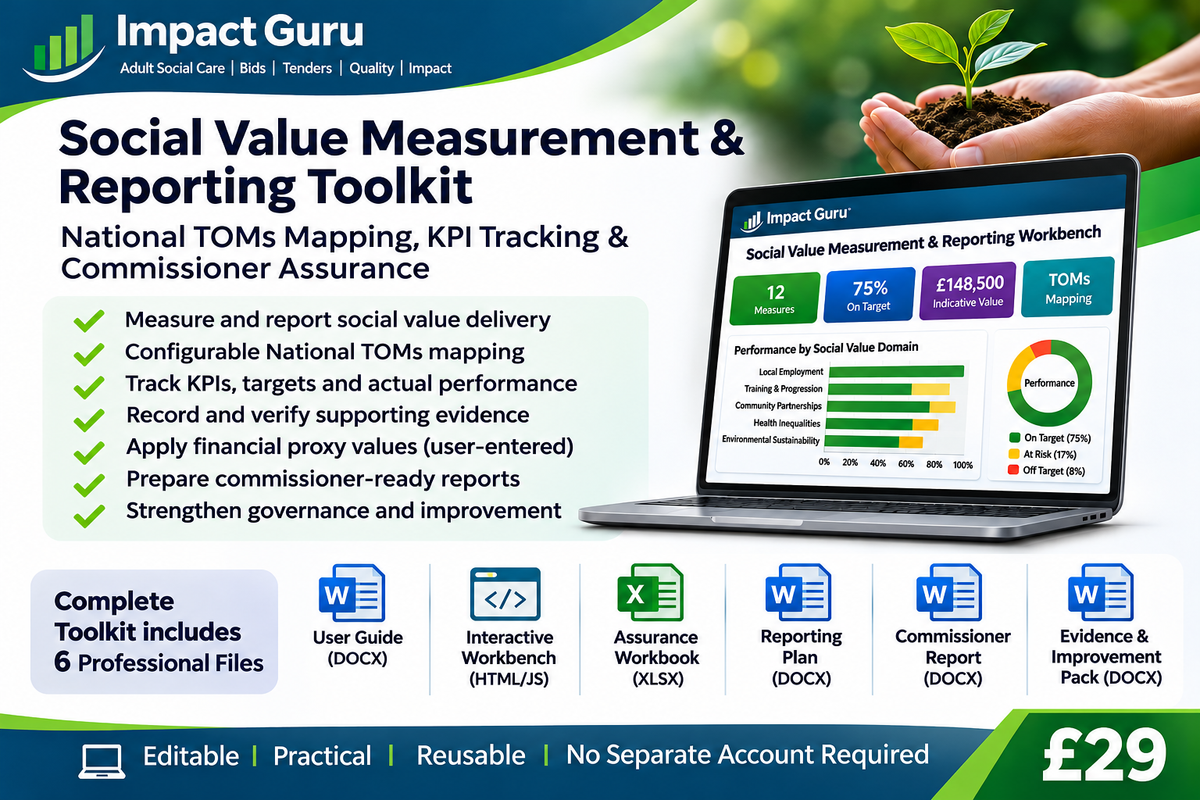
Version 1.1 is supplied as a single downloadable ZIP archive containing six professional toolkit files.
The package includes:
- One comprehensive Configuration, Testing & Governance User Guide in Microsoft Word format.
- One interactive HTML/JavaScript Social Value Measurement & Reporting Workbench.
- One editable Microsoft Excel Social Value Measurement & Assurance Workbook, including TOMs mapping and valuation arrangements.
- One editable Social Value Measurement & Reporting Plan in Microsoft Word format.
- One editable Commissioner Social Value Performance Report in Microsoft Word format.
- One editable Evidence Verification, Case Studies & Improvement Pack in Microsoft Word format.
The files are numbered in their recommended order of use. Each component supports a different stage of social value planning, measurement, assurance, reporting and improvement.
1. Configuration, Testing & Governance User Guide
A professionally formatted guide explaining the toolkit's purpose, structure, configuration requirements and recommended operating arrangements.
The guide explains how the interactive workbench, Excel workbook and Word documents can be used together to establish a consistent social value measurement and reporting process.
It covers the selection of suitable indicators, establishment of baselines and targets, reporting periods, evidence verification, National TOMs mapping, financial proxy considerations and governance responsibilities.
The guide also addresses testing, data handling, version control, management review and the importance of checking outputs before using them in commissioner submissions or external reports.
The Configuration, Testing & Governance User Guide is File 01 and should be read before using the other toolkit components.
2. Interactive Social Value Measurement & Reporting Workbench
An interactive HTML/JavaScript workbench that can be opened locally in a compatible modern desktop web browser without requiring a separate online account.
The workbench provides a practical environment for configuring social value measures, recording performance, reviewing supporting evidence and preparing reporting outputs.
Key capabilities include:
- Twelve starter social value measures.
- Ability to configure additional measures relevant to organisational and contractual requirements.
- Recording of commitments, targets and actual delivery.
- Performance comparison and identification of variances.
- Evidence review and assurance prompts.
- Configurable TOMs or commissioner framework mapping fields.
- Indicative monetary valuation calculations using user-entered proxy values.
- Structured reporting outputs for management and commissioner review.
- CSV export for further analysis.
- Save My Report Data and Open a Saved Report functions for continuing work across sessions.
- Printable reporting outputs that can be saved as PDF documents through the browser's print function.
The workbench is designed to support repeated reporting rather than a single assessment.
Users can save their working information locally and reopen it when preparing subsequent reports. The underlying saved-data format is JSON, but users do not need programming knowledge to use the save and reopen functions.
Important: Performance results and financial valuations depend on the information, targets, mapping references and proxy values entered by users. The workbench does not independently validate reported social value achievements or certify National TOMs compliance.
3. Social Value Measurement & Assurance Workbook
A professionally formatted, editable Microsoft Excel workbook providing a structured environment for managing social value commitments, performance information, evidence, assurance and reporting.
The workbook contains connected worksheets supporting the social value measurement and governance process, including dedicated arrangements for TOMs mapping and valuation.
Its features include:
- Structured social value commitments and KPI recording tables.
- Baseline, target and actual performance fields.
- Performance variance and progress monitoring.
- Social value evidence recording and verification.
- Outcome and benefit reporting.
- National TOMs and commissioner-specific framework mapping.
- Financial proxy value recording and indicative valuation calculations.
- Improvement action tracking.
- Governance and management assurance information.
- Commissioner reporting preparation.
The workbook uses formatted recording tables with visible borders, structured headings and clearly identified fields to support practical use.
It enables organisations to consolidate social value information and identify where further evidence, management investigation or corrective action may be required.
Important: Any illustrative measures, reporting arrangements or calculation assumptions must be reviewed and adapted to the organisation's contractual commitments, commissioner requirements and applicable social value framework.
4. Social Value Measurement & Reporting Plan
A professionally formatted, editable Microsoft Word document for establishing an organisation's social value delivery and reporting arrangements.
The plan provides structured sections and tables for:
- Organisational and contractual context.
- Social value priorities and intended outcomes.
- Commitments, measures, baselines and targets.
- National TOMs or local commissioner framework references.
- Delivery responsibilities and reporting timescales.
- Evidence collection and verification arrangements.
- Performance review and escalation procedures.
- Governance responsibilities and approval arrangements.
The document helps organisations establish a consistent approach before collecting performance information and preparing commissioner reports.
5. Commissioner Social Value Performance Report
A professionally formatted, editable Microsoft Word report designed for presenting social value performance to commissioners, contract managers, senior leaders and governance committees.
The report provides structured reporting sections for:
- Executive summary of social value delivery.
- Original commitments and agreed reporting measures.
- Performance against targets.
- Relevant TOMs or commissioner framework mapping.
- Evidence supporting reported achievements.
- Indicative financial valuations where applicable.
- Community and service-user outcomes.
- Delivery exceptions and emerging concerns.
- Corrective actions and improvement priorities.
- Management commentary, review and approval.
The report encourages organisations to explain not only what has been delivered, but also how achievements have been verified, what benefits have resulted and what further action is required.
It can be adapted to individual contract reporting requirements and used alongside commissioner-specified templates where these are mandatory.
6. Evidence Verification, Case Studies & Improvement Pack
An editable Microsoft Word resource supporting the verification, interpretation and improvement of social value reporting.
The pack provides structured checklists, evidence review arrangements, case study recording sections and improvement documentation.
It supports users in examining:
- Whether reported achievements are supported by appropriate records.
- Whether evidence is relevant to the measure being reported.
- Whether outcomes are distinguishable from activities and outputs.
- Whether claims are attributable to the organisation's contribution.
- Whether financial proxy assumptions are documented and appropriate.
- Whether duplicate counting or unsupported claims may be present.
- Whether case studies accurately reflect the experiences and outcomes of people involved.
- Whether evidence gaps require further investigation.
- Whether corrective actions have named owners and review dates.
- Whether management approval and reporting decisions have been recorded.
The pack helps strengthen the credibility of social value reporting by connecting numerical information with supporting evidence, qualitative outcomes and governance scrutiny.
Social Value Measurement Domains
The toolkit builds on the priorities explored within the free Impact Guru Social Value Report Builder and extends them into structured performance monitoring and assurance.
Relevant measurement domains include:
- Local Employment: Local recruitment, jobs created or sustained, employment access and retention.
- Workforce Training and Progression: Apprenticeships, placements, skills development, professional learning and career progression.
- Community Partnerships: Local partnerships, community projects, volunteering and collaborative initiatives.
- Health Inequalities: Activities and outcomes supporting improved access, inclusion, prevention and reduced barriers to services.
- Digital Inclusion: Digital skills, accessible technology, communication, independence and participation.
- Environmental Sustainability: Resource efficiency, travel reduction, waste management, energy use and sustainable procurement.
- Co-production and Lived Experience: Meaningful involvement of people receiving support and evidence of changes resulting from their contributions.
- Local Supply Chains: Local supplier expenditure, procurement opportunities and local economic participation.
- Social Inclusion and Community Participation: Opportunities for people to participate in employment, education, volunteering and community life.
- Service-User Outcomes: Independence, choice, wellbeing, participation and outcomes that can be credibly connected to social value commitments.
These domains provide a practical starting point. Individual organisations must select measures relevant to their contracts, services, commissioner priorities and intended beneficiaries.
Not every activity automatically constitutes additional social value. Organisations should distinguish between ordinary contractual service delivery, statutory or regulatory obligations and additional benefits that meet the relevant commissioner's social value requirements.
National TOMs Alignment and Commissioner Framework Mapping
National TOMs — Themes, Outcomes and Measures — provides a structured approach to defining, measuring and reporting social value.
However, commissioners may adopt different editions, selected measures, local adaptations or entirely separate social value frameworks. Reporting requirements can therefore vary between contracts and commissioning organisations.
The Social Value Measurement & Reporting Toolkit — Version 1.1 includes configurable TOMs mapping and valuation arrangements to help users organise their reporting against the framework applicable to their contract.
The toolkit supports the recording of:
- The social value theme and intended outcome.
- The relevant framework or commissioner methodology.
- The applicable measure reference.
- The measurement unit and reporting basis.
- The agreed target and actual achievement.
- Supporting evidence and verification status.
- Approved financial proxy values where relevant.
- Indicative monetary valuations and associated assumptions.
- Review responsibilities and assurance commentary.
The toolkit does not contain a licensed National TOMs catalogue or automatically assign official measure codes or financial proxy values.
Users must obtain the relevant framework documentation, confirm which measures apply and enter authorised references and values where appropriate.
The toolkit is therefore designed to support National TOMs-informed measurement and configurable framework mapping, rather than claim formal certification, accreditation or endorsement by the framework owner.
Using Financial Proxy Values Responsibly
Some social value methodologies allow specified activities or outcomes to be assigned monetary proxy values.
These valuations can help organisations present a consistent estimate of wider economic, social or environmental benefit when an appropriate methodology has been agreed.
However, monetary social value figures are not necessarily equivalent to cash savings, additional organisational income, direct public expenditure reductions or independently verified economic impact.
The toolkit provides fields and calculations that can support indicative valuations using values entered by the user.
Before presenting monetary social value figures externally, organisations should confirm:
- Which valuation methodology is applicable.
- Whether the selected proxy value is current and authorised for the intended purpose.
- Whether the activity meets the relevant measure definition.
- Whether the achievement is supported by sufficient evidence.
- Whether the calculation includes appropriate units, periods and eligibility conditions.
- Whether double counting or overlapping benefits have been avoided.
- Whether the reported value is appropriately described as an estimate rather than a cash saving.
- Whether the commissioner accepts the selected valuation approach.
A financial proxy calculation should support transparent reporting, not replace evidence of real outcomes or create an impression of certainty that the underlying data cannot justify.
From Social Value Commitments to Verified Outcomes
One of the most common weaknesses in social value reporting is the gap between what an organisation promises and what it can demonstrate during contract delivery.
A provider may commit to recruiting locally, creating apprenticeship opportunities, supporting community projects or reducing environmental impacts. These commitments can be valuable, but they need to be translated into measurable delivery arrangements.
For example, reporting that an organisation has established a community partnership does not necessarily demonstrate the benefits experienced by people using services or the wider community.
Similarly, reporting that staff have completed training does not automatically demonstrate improved workforce capability, career progression or better outcomes for people receiving support.
The toolkit encourages organisations to ask:
- What exactly did we commit to deliver?
- How was the baseline established?
- What measure and target have been agreed?
- What activity has actually taken place?
- What evidence supports the reported achievement?
- What changed for the intended beneficiaries?
- Can the benefit reasonably be attributed to our contribution?
- Have we avoided counting the same benefit more than once?
- Are we meeting the commissioner's reporting requirements?
- What corrective action is required where delivery is below expectations?
Credible social value reporting depends on the quality of the evidence and the reality of the benefits delivered, not simply the number of activities recorded or the monetary value calculated.
Who Is This Toolkit For?
The Social Value Measurement & Reporting Toolkit is designed for professionals responsible for planning, delivering, measuring and reporting social value across adult social care and related public service organisations.
- Adult social care provider directors and senior leaders.
- Registered Managers and service managers.
- Business development and tender managers.
- Social value and community engagement leads.
- Quality assurance and compliance managers.
- Operations and contract managers.
- Commissioning and procurement professionals.
- Local authority and NHS contract management teams.
- Board members and trustees.
- Housing support and community service providers.
- VCSE organisations and charities.
- Independent health and social care consultants.
It is particularly relevant to organisations delivering supported living, learning disability and autism support, homecare, mental health services, older people's care, community health services, housing-related support and other publicly commissioned services.
The resources can be adapted for individual contracts, multi-site providers, organisation-wide social value reporting and internal governance arrangements.
How the Toolkit Works
Step 1 — Read the Configuration & User Guide
Begin with File 01 to understand the toolkit's structure, configuration requirements, reporting assumptions and recommended workflow.
Step 2 — Identify Your Social Value Commitments
Review the relevant tender submission, contract specification, commissioner reporting framework and organisational social value priorities.
Identify commitments that require measurable delivery and confirm which activities and outcomes are relevant.
Step 3 — Configure Measures and Framework Mapping
Select appropriate indicators, establish baselines and targets, and record reporting periods and accountable owners.
Where applicable, enter the relevant National TOMs or commissioner-specific measure references and confirm any approved financial proxy values.
Step 4 — Record Actual Delivery
Use the interactive workbench and Excel workbook to enter performance information and compare actual achievements against commitments.
Record supporting evidence and identify where information remains incomplete or requires verification.
Step 5 — Review Evidence and Valuation
Examine the reliability of supporting records, confirm eligibility for relevant measures and review any monetary valuation calculations.
Use the Evidence Verification, Case Studies & Improvement Pack to strengthen assurance and document qualitative outcomes.
Step 6 — Identify Exceptions and Improvement Actions
Review underperformance, missing evidence, inconsistent data and commitments requiring further management attention.
Record corrective actions, responsible owners, deadlines and review arrangements.
Step 7 — Prepare Commissioner Reporting
Use the Commissioner Social Value Performance Report to communicate achievements, supporting evidence, delivery exceptions, indicative valuations and improvement priorities.
Adapt the report to the commissioner's required format and obtain appropriate internal approval before submission.
Step 8 — Review, Update and Repeat
Repeat the process at agreed reporting intervals, review whether corrective actions have improved delivery and maintain an appropriate evidence trail.
Use the resulting information to improve future social value commitments, tender submissions, contract delivery and organisational planning.
Designed for Practical, Repeated Use
The Social Value Measurement & Reporting Toolkit is designed as a reusable professional management resource rather than a single-use report generator.
The HTML workbench operates locally in a compatible browser, while the Excel workbook and Word documents can be edited to reflect organisational and contractual requirements.
Professionally formatted tables, structured recording fields, configurable measures, evidence review arrangements and reporting templates support practical use within established management and governance processes.
The toolkit does not require a separate Impact Guru application subscription or ongoing online account for its core offline functions.
Important: Users are responsible for protecting working files, maintaining backups, controlling access permissions and avoiding unnecessary inclusion of identifiable personal or sensitive information. The toolkit is not a secure hosted contract management system or evidence repository.
Free Social Value Report Builder or Professional Toolkit?
Impact Guru also provides a free online Social Value Report Builder to help adult social care organisations establish a social value reporting framework.
The free resource provides suggested KPIs, evidence sources, governance prompts, commissioner-friendly wording and an indicative social value readiness assessment.
It is intended to help organisations understand the information and arrangements that may be required for effective social value reporting.
The downloadable Social Value Measurement & Reporting Toolkit serves a broader operational purpose.
It provides editable commitment and KPI recording tools, an interactive measurement workbench, a multi-worksheet Excel assurance workbook, configurable TOMs mapping, evidence verification arrangements, performance reporting templates and reusable improvement documentation.
The free resource helps organisations establish a social value reporting framework. The professional toolkit provides the working resources needed to measure actual delivery, verify evidence, monitor commitments and prepare structured commissioner reports.
Download Format and Technical Requirements
- Delivery: Digital download supplied as a ZIP archive.
- Version: 1.1.
- Package: Six files.
- File 01: Configuration, Testing & Governance User Guide — editable DOCX.
- File 02: Interactive Social Value Measurement & Reporting Workbench — HTML/JavaScript.
- File 03: Social Value Measurement & Assurance Workbook — editable XLSX.
- File 04: Social Value Measurement & Reporting Plan — editable DOCX.
- File 05: Commissioner Social Value Performance Report — editable DOCX.
- File 06: Evidence Verification, Case Studies & Improvement Pack — editable DOCX.
- Internet connection: Not required for the core offline workbench and document-editing functions.
- Account: No separate Impact Guru application account required.
- Recommended environment: Desktop or laptop computer with compatible Microsoft Office applications and a modern web browser.
- Data saving: Local report data can be saved and reopened using the interactive workbench's file functions.
- Framework updates: Users must check current National TOMs, commissioner-specific frameworks and approved financial proxy values independently.
- Updates: The toolkit does not automatically retrieve changes to social value methodologies, procurement requirements, legislation or commissioner reporting standards.
This is a downloadable professional management toolkit, not a hosted software subscription, official National TOMs product, independent social value audit, financial valuation certification or bespoke consultancy engagement.
About Impact Guru
Impact Guru provides specialist bid strategy, tender writing, quality assurance and professional intelligence resources for organisations operating across adult social care and related public service sectors.
The Social Value Measurement & Reporting Toolkit reflects an evidence-led approach to social value delivery, measurable outcomes, commissioner accountability and continuous improvement.
It is designed to help organisations strengthen the connection between the social value commitments made during procurement and the outcomes demonstrated during contract delivery.
Important Professional, Methodology and Technical Disclaimer
The Social Value Measurement & Reporting Toolkit is an independent professional management resource developed by Impact Guru Ltd.
It is not affiliated with, endorsed by, certified by or officially licensed as a National TOMs product by the framework owner.
The toolkit provides configurable mapping fields and valuation functionality. It does not include a licensed National TOMs measure catalogue, automatically assign official measure codes or supply authoritative financial proxy values.
Users must independently verify applicable National TOMs editions, commissioner-specific social value frameworks, measurement definitions, evidence requirements and valuation methodologies before using outputs for contractual reporting or procurement submissions.
Reported achievements, performance comparisons and financial valuations depend on the accuracy, completeness and interpretation of information entered by users.
Indicative monetary social value calculations should not be presented as independently verified economic impact, realised cash savings or guaranteed public benefit without an appropriate supporting methodology and evidence.
The toolkit does not replace professional judgement, contractual reporting requirements, commissioner instructions, independent verification, financial advice, legal advice, information governance obligations or specialist social value assessment.
Users must consider the legislation, procurement rules, reporting standards and contractual obligations applicable to their own activities. These requirements may change over time.
The toolkit does not automatically update when frameworks, methodologies, legislation or commissioner requirements change.
Digital product: Please review the product description, technical requirements and applicable digital-product terms before purchasing.
Share