Impact Guru
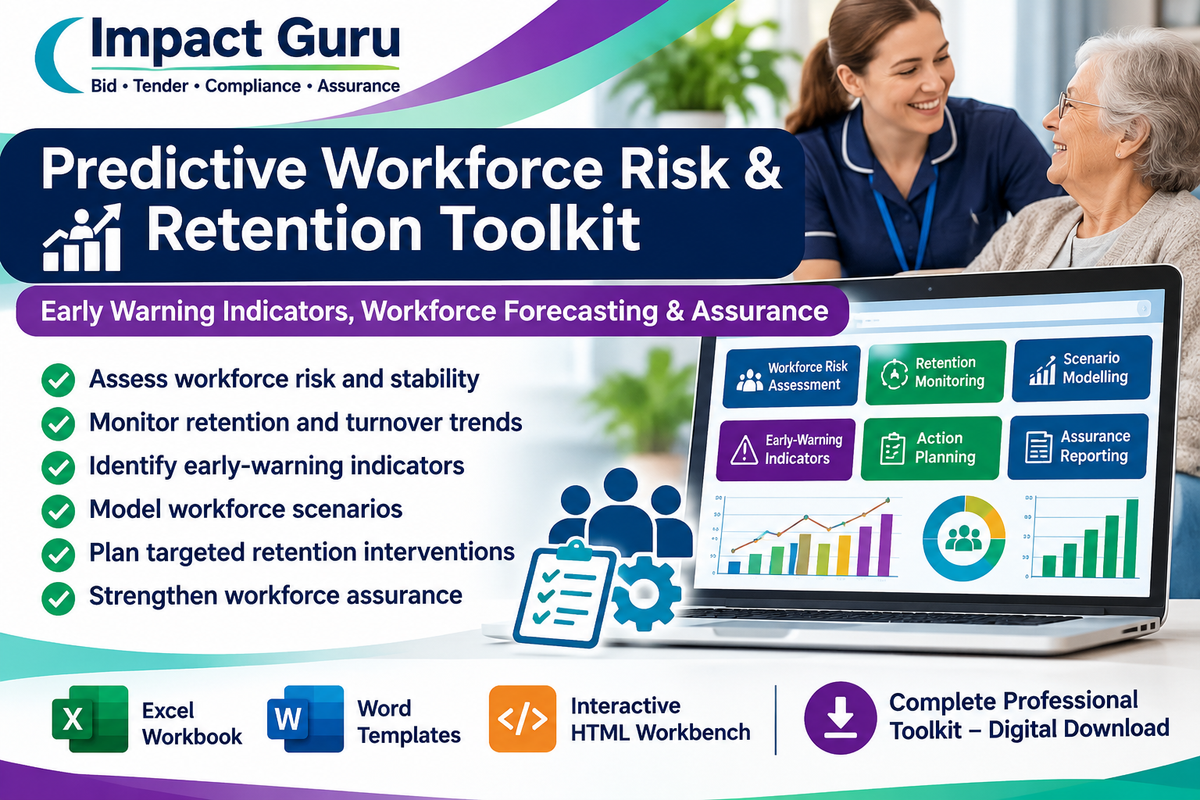
Predictive Workforce Risk & Retention Toolkit | Early Warning Indicators, Workforce Forecasting & Assurance
Predictive Workforce Risk & Retention Toolkit | Early Warning Indicators, Workforce Forecasting & Assurance
Couldn't load pickup availability
Predictive Workforce Risk & Retention Toolkit — Version 1.0
A practical, self-configurable workforce risk assessment, retention planning, early-warning monitoring and workforce assurance toolkit for adult social care providers and related public service organisations in the UK.
Workforce instability rarely develops from a single problem. Recruitment difficulties, increasing staff turnover, sickness absence, reliance on temporary staffing, management vacancies and declining employee engagement can combine to create serious pressures on service continuity, care quality, safeguarding, operational capacity and financial sustainability.
These pressures can become established before conventional workforce reporting identifies the full extent of the problem. A provider may continue filling shifts through overtime and agency workers while underlying retention difficulties, recruitment delays and workforce fatigue gradually weaken organisational resilience.
The Impact Guru Predictive Workforce Risk & Retention Toolkit — Version 1.0 has been developed to help organisations move beyond retrospective workforce reporting towards a more structured, preventative approach to identifying workforce risks, evaluating emerging pressures and planning targeted interventions.
The toolkit combines workforce indicators, transparent risk scoring, scenario-based modelling, retention planning, recruitment analysis, evidence assurance and management reporting within a connected set of professional resources.
It brings together an interactive offline HTML/JavaScript workbench, an editable Microsoft Excel workforce intelligence workbook and professionally formatted Microsoft Word documents.
These resources help organisations connect workforce data, emerging risks, retention interventions, operational consequences and governance accountability within a repeatable workforce assurance process.
The toolkit is designed for repeated use during monthly workforce reviews, quarterly governance reporting, recruitment and retention planning, service recovery programmes, contract assurance and workforce sustainability assessments.
What Can the Toolkit Help You Achieve?
The toolkit provides a practical framework for understanding current workforce pressures, identifying emerging instability and assessing how different workforce scenarios may affect future service delivery.
- Identify early-warning indicators: Monitor vacancy levels, staff turnover, sickness absence, agency dependence, overtime, recruitment performance and workforce continuity.
- Assess workforce risk: Use transparent scoring arrangements to identify areas requiring management attention and prioritise further investigation.
- Strengthen retention planning: Examine workforce loss, early-tenure retention, management capability, staff experience and factors contributing to preventable turnover.
- Improve recruitment intelligence: Review recruitment pipelines, candidate conversion, time to hire, workforce supply and the relationship between recruitment activity and staffing requirements.
- Model workforce scenarios: Explore the potential implications of changes in turnover, recruitment, vacancies and other workforce pressures using configurable assumptions.
- Monitor service continuity: Consider how workforce instability affects familiar-worker support, rota resilience, service capacity and operational sustainability.
- Evaluate workforce interventions: Establish measurable improvement actions and review whether recruitment, retention and workforce-support initiatives are producing results.
- Strengthen workforce governance: Record workforce risks, assign responsibilities, define escalation arrangements and provide structured assurance to senior leaders.
- Improve evidence quality: Identify gaps in workforce information and strengthen the reliability of HR, recruitment, rota, training and operational evidence.
- Prepare management reports: Consolidate workforce findings, emerging concerns, planned interventions and progress information for board, commissioner and contract review purposes.
- Support workforce recovery: Develop structured 30, 60 and 90-day improvement plans for services experiencing persistent workforce pressure.
- Strengthen organisational resilience: Connect workforce planning with quality assurance, safeguarding, financial sustainability and business continuity arrangements.
The emphasis is on moving from reactive vacancy management and retrospective workforce statistics towards earlier identification, targeted intervention, measurable improvement and accountable workforce assurance.
What's Included in Your Download?
Version 1.0 is supplied as a single downloadable ZIP archive containing six professional toolkit files.
The package includes:
- One comprehensive User Guide & Implementation Manual in Microsoft Word format.
- One interactive HTML/JavaScript Predictive Workforce Risk & Retention Workbench.
- One editable Microsoft Excel Workforce Intelligence & Scenario Workbook.
- One editable 30/60/90-Day Workforce Retention Action Plan in Microsoft Word format.
- One editable Board & Commissioner Workforce Assurance Report in Microsoft Word format.
- One editable Workforce Evidence, Intervention & Review Pack in Microsoft Word format.
The files are numbered in their recommended order of use. Together, they provide a structured approach to workforce assessment, early-warning monitoring, scenario analysis, improvement planning, evidence verification and governance reporting.
1. User Guide & Implementation Manual
A professionally formatted Microsoft Word guide explaining the toolkit's purpose, structure, configuration requirements, operating assumptions and recommended implementation arrangements.
The guide explains how the interactive workbench, Excel workbook and Word documents can be used together to establish a consistent workforce risk and retention management process.
It covers:
- Understanding the toolkit's six components.
- Establishing an appropriate workforce assessment scope.
- Selecting and validating workforce indicators.
- Interpreting workforce risk and resilience scores.
- Understanding scenario assumptions and modelling limitations.
- Identifying workforce evidence sources.
- Setting appropriate organisational risk thresholds.
- Developing retention and recruitment interventions.
- Establishing workforce governance and escalation arrangements.
- Testing and reviewing outputs before management use.
- Managing locally saved information, version control and data protection.
- Integrating toolkit outputs into existing workforce and quality assurance processes.
The guide supports practical implementation while emphasising the need for organisational judgement, reliable source information and proportionate governance.
The User Guide & Implementation Manual is File 01 and should be read before using the remaining toolkit components.
2. Interactive Predictive Workforce Risk & Retention Workbench
An interactive HTML/JavaScript workbench that can be opened locally in a compatible modern desktop web browser without requiring a separate online account.
The workbench provides a structured environment for entering workforce information, examining current risks, reviewing resilience and considering the potential effects of different workforce scenarios.
Key capabilities include:
- Configurable organisational and workforce assessment information.
- Workforce baseline recording and review.
- Assessment of key recruitment, retention and staffing indicators.
- Structured assessment across eight workforce resilience domains.
- Transparent workforce risk scoring.
- Workforce resilience assessment.
- Identification of early-warning indicators and areas requiring management attention.
- Recruitment and retention pressure analysis.
- Workforce scenario modelling using user-defined assumptions.
- Identification of potential service-continuity pressures.
- Targeted workforce improvement recommendations.
- Structured management reporting outputs.
- Save My Assessment Data and Open a Saved Assessment functions for continuing work across sessions.
- Printable assessment reports that can be saved as PDF documents using the browser's print function.
The workbench is intended for repeated workforce assessments rather than a single diagnostic exercise.
Users can save their working information locally and reopen it when updating workforce indicators, reviewing emerging risks or preparing subsequent management reports.
The underlying saved-data format is JSON, but users do not need programming knowledge to use the save and reopen functions.
Important: The workbench provides rules-based risk assessment and scenario modelling. It does not use a statistically trained artificial intelligence model, independently predict individual employee departures or guarantee future workforce outcomes.
Results depend on the accuracy of user-entered data, the assumptions applied and the suitability of the scoring thresholds for the organisation being assessed.
3. Workforce Intelligence & Scenario Workbook
A professionally formatted, editable Microsoft Excel workbook providing a structured environment for workforce performance monitoring, recruitment analysis, risk assessment, scenario planning and management assurance.
The workbook supports the recording and review of workforce information over time, helping organisations identify deterioration, compare performance and document interventions.
Its features include:
- Workforce baseline and key performance indicator recording.
- Monthly workforce performance monitoring.
- Vacancy, turnover, absence and temporary staffing information.
- Recruitment pipeline and conversion analysis.
- Workforce risk and early-warning monitoring.
- Scenario planning and configurable workforce assumptions.
- Retention and recruitment improvement tracking.
- Workforce risk register and escalation information.
- Management review and assurance arrangements.
- Dashboard-style workforce performance summaries.
The workbook uses professionally formatted recording tables with visible cell borders, structured headings and clearly identified fields to support readability and practical use.
It provides a reusable record of workforce performance and management responses, supporting comparison between reporting periods.
Important: Illustrative thresholds, scenario assumptions and calculations must be reviewed against the organisation's workforce structure, operating model and validated source data before being used for decisions.
4. 30/60/90-Day Workforce Retention Action Plan
A professionally formatted, editable Microsoft Word document for developing and monitoring a structured workforce recovery, retention or improvement programme.
The action plan provides recording sections and bordered tables for:
- Current workforce challenges and priority risks.
- Immediate actions during the first 30 days.
- Improvement interventions during days 31 to 60.
- Evaluation and consolidation during days 61 to 90.
- Recruitment and retention priorities.
- Management and workforce-support interventions.
- Named action owners and delivery timescales.
- Measurable improvement indicators.
- Evidence of completed activity.
- Progress monitoring, review and escalation.
The plan helps organisations translate workforce risk findings into practical actions with clear responsibilities and review arrangements.
It can be adapted for individual services, regional operations, organisation-wide workforce programmes or targeted retention initiatives.
5. Board & Commissioner Workforce Assurance Report
A professionally formatted, editable Microsoft Word report designed for presenting workforce stability, emerging risks, interventions and assurance information to senior leaders, boards, commissioners and contract management teams.
The report provides structured sections for:
- Executive summary of the workforce position.
- Assessment scope and workforce context.
- Workforce baseline and key performance indicators.
- Current workforce risk and resilience findings.
- Recruitment and retention pressures.
- Service continuity and operational implications.
- Early-warning indicators and emerging concerns.
- Workforce scenario considerations.
- Evidence quality and limitations.
- Management interventions and improvement priorities.
- Residual risks and escalation requirements.
- Management commentary, review and approval.
The report encourages organisations to explain not only the current workforce figures, but also what those figures mean for service delivery, what management action is being taken and how improvement will be evidenced.
It can be adapted to local commissioner requirements and used alongside mandatory contract monitoring or regulatory reporting templates where applicable.
6. Workforce Evidence, Intervention & Review Pack
An editable Microsoft Word resource supporting workforce evidence verification, root-cause analysis, intervention evaluation and ongoing management review.
The pack provides structured recording tables, review prompts and evidence-assurance arrangements.
It supports users in examining:
- Whether workforce figures are current, complete and reliable.
- Whether data from HR, payroll, rotas and recruitment systems is consistent.
- Whether workforce risks are concentrated within particular services, roles or geographical areas.
- Whether staff feedback and exit information explain observed trends.
- Whether management or organisational factors contribute to workforce instability.
- Whether recruitment and retention interventions address identified causes.
- Whether improvement activity is producing measurable results.
- Whether workforce risks have implications for service continuity, quality or safeguarding.
- Whether evidence gaps require further investigation.
- Whether corrective actions have named owners and review dates.
- Whether management decisions and assurance conclusions have been documented.
The pack helps strengthen the connection between workforce data, operational evidence, management decisions and demonstrable improvement.
The Word documents include clearly bordered tables and checkbox-style controls to support practical completion and review in compatible Microsoft Word environments.
Eight Workforce Resilience Assessment Domains
The toolkit builds on the themes explored within the free Impact Guru Predictive Workforce Risk Module and extends them into repeatable assessment, monitoring and improvement arrangements.
The eight assessment domains address the main organisational factors influencing workforce stability and retention.
- Workforce Capacity and Vacancy Resilience: Staffing availability, vacancy pressure, hard-to-fill posts and the ability to maintain required service capacity.
- Recruitment Pipeline and Workforce Supply: Applicant quality, recruitment conversion, time to hire, offer acceptance and the sustainability of recruitment arrangements.
- Retention and Workforce Stability: Staff turnover, early-tenure losses, retention patterns, workforce movement and reasons for leaving.
- Wellbeing, Absence and Workforce Experience: Sickness absence, workload, staff engagement, fatigue, morale and employee experience.
- Leadership and Management Resilience: Management stability, supervision, management capacity, succession arrangements and leadership support.
- Training, Competence and Workforce Capability: Essential training, practical competency assurance, workforce development and skill-mix resilience.
- Service Continuity and Operational Stability: Familiar-worker continuity, rota resilience, agency reliance, overtime and the effect of workforce pressures on service delivery.
- Workforce Intelligence and Governance: Data quality, risk monitoring, escalation, management oversight, evidence assurance and improvement accountability.
These domains help organisations examine the connections between workforce capacity, employee experience, operational performance and the quality of services received by people requiring support.
Strong performance in one domain does not automatically compensate for serious weaknesses elsewhere. For example, a provider may have good training compliance but still face significant continuity risks because of high turnover, vacancies or management instability.
Predictive Workforce Risk: What Does It Mean?
Workforce prediction in an operational management context involves using current indicators, historical trends and defined assumptions to identify where workforce pressures may develop or worsen.
For adult social care providers, this can involve examining the relationship between:
- Existing workforce capacity and unfilled posts.
- Staff turnover and expected replacement demand.
- Recruitment performance and the time required to restore staffing capacity.
- Sickness absence and the availability of effective working hours.
- Agency use, overtime and the sustainability of temporary cover.
- Early-tenure retention and the effectiveness of recruitment and induction.
- Management stability and the organisation's ability to respond to pressure.
- Workforce continuity and the experience of people receiving support.
These relationships can help managers identify potential deterioration before it becomes visible through major service disruption.
For example, an organisation experiencing increasing turnover, longer recruitment times and rising overtime may face growing staffing pressure even if its current vacancy rate appears manageable.
Similarly, a service experiencing repeated management changes and declining supervision compliance may face retention and quality risks that are not immediately apparent from workforce headcount alone.
The toolkit provides a structured way to examine these combinations and consider proportionate management responses.
The predictive element is based on transparent early-warning indicators and scenario assumptions, not on machine-learning predictions or independently validated statistical forecasts.
Workforce Scenario Modelling and Forward Planning
Scenario modelling helps organisations explore how changes in workforce conditions could affect future staffing requirements and operational resilience.
Rather than relying on a single forecast, managers can examine alternative assumptions and consider how the organisation might respond.
Relevant scenarios may include:
- Higher turnover: What happens if the rate of staff departures increases?
- Improved retention: How might reduced workforce losses affect recruitment demand?
- Recruitment delays: What are the implications of longer vacancy-filling times?
- Improved recruitment conversion: How could better applicant-to-start performance affect workforce capacity?
- Increasing absence: How might higher sickness absence affect available staffing hours?
- Temporary staffing pressure: What happens when agency reliance or overtime becomes difficult to sustain?
- Workforce recovery: How might a combination of retention improvements and stronger recruitment performance support gradual stabilisation?
The interactive workbench and Excel workbook provide complementary resources for exploring workforce assumptions and recording the implications for management planning.
Scenario outputs should be treated as planning illustrations rather than guaranteed forecasts. Actual workforce outcomes will depend on local labour markets, recruitment conditions, employee behaviour, organisational decisions and wider operational circumstances.
Organisations should document the assumptions used and review them against subsequent workforce performance.
From Workforce Data to Retention Interventions
Collecting workforce statistics is only useful when the information supports better decisions.
A high turnover rate, for example, may have several different causes. These could include pay competitiveness, workload, management practice, unpredictable rotas, limited progression opportunities, inadequate induction or differences between services.
An organisation-wide retention initiative may therefore achieve limited results if the underlying causes vary substantially between teams.
The toolkit encourages organisations to examine:
- Which workforce groups are experiencing the greatest instability?
- At what point in employment are staff most likely to leave?
- Are particular services, managers or shift patterns associated with higher turnover?
- What do exit interviews, supervision records and staff feedback indicate?
- Are recruitment difficulties caused by insufficient applications or poor conversion?
- Are temporary staffing arrangements concealing structural vacancies?
- Are staff wellbeing and workload pressures affecting retention?
- What effect is workforce instability having on people receiving support?
- Which interventions are affordable, proportionate and operationally realistic?
- How will the organisation know whether the intervention has worked?
The 30/60/90-Day Workforce Retention Action Plan and Workforce Evidence, Intervention & Review Pack provide practical resources for translating these findings into measurable improvement programmes.
The aim is not simply to reduce a headline turnover percentage, but to improve workforce stability, staff experience, service continuity and sustainable organisational performance.
Connecting Workforce Stability With Care Quality and Safeguarding
Workforce risks in adult social care have consequences beyond recruitment expenditure and staffing efficiency.
People receiving support may depend on consistent relationships, reliable communication, specialist knowledge and staff who understand their preferences, needs and risks.
Persistent workforce instability can undermine these arrangements, particularly where services support people with complex communication needs, learning disabilities, autism, mental health needs, dementia or high levels of personal care dependency.
Potential consequences include:
- Reduced continuity of familiar-worker support.
- Greater reliance on temporary or unfamiliar staff.
- Increased pressure on experienced team members.
- Reduced capacity for supervision and reflective practice.
- Delayed training or practical competency assessment.
- Greater risk of communication failures or inconsistent support.
- Reduced capacity for proactive care planning and community participation.
- Management attention being diverted towards immediate staffing problems.
- Increased vulnerability during mobilisation, expansion or service recovery.
The toolkit encourages organisations to consider workforce indicators alongside service quality, safeguarding, continuity and the experiences of people receiving support.
Where staffing arrangements create immediate safety concerns, organisations must act through their established operational, safeguarding, regulatory and escalation procedures rather than wait for a toolkit assessment or scheduled management review.
Workforce Governance and Board Assurance
Workforce sustainability requires effective oversight, particularly where staffing difficulties affect contractual delivery, financial performance, quality assurance or service continuity.
Senior leaders and boards need to understand not only the current workforce position, but also the direction of travel, emerging risks, evidence limitations and effectiveness of management interventions.
The toolkit supports a more structured approach to workforce governance through:
- Consistent workforce performance indicators.
- Clear assessment scope and reporting periods.
- Defined workforce risk thresholds and escalation arrangements.
- Documented management ownership.
- Identification of service-level vulnerabilities.
- Structured retention and recruitment improvement actions.
- Evidence verification and data-quality review.
- Monitoring of workforce interventions and their results.
- Reporting of residual risks and required decisions.
- Integration with wider quality, safeguarding and business continuity governance.
The Board & Commissioner Workforce Assurance Report provides a reusable structure for presenting workforce information alongside management interpretation, corrective action and assurance conclusions.
It can support internal board reporting, provider governance committees, operational performance meetings and appropriate commissioner discussions.
It does not replace mandatory regulatory notifications, contractual reporting obligations or organisation-specific governance requirements.
Who Is This Toolkit For?
The Predictive Workforce Risk & Retention Toolkit is designed for professionals responsible for workforce stability, recruitment, retention, service continuity and organisational assurance.
- Adult social care provider directors and senior leaders.
- Registered Managers and service managers.
- Operations and regional managers.
- Workforce and HR directors.
- Recruitment and retention leads.
- Learning and development managers.
- Quality assurance and compliance professionals.
- Finance and business planning leads.
- Board members and trustees.
- Commissioners and contract management professionals.
- Local authority and NHS workforce planning teams.
- Business continuity and organisational improvement leads.
- Independent health and social care consultants.
It is particularly relevant to organisations delivering supported living, learning disability and autism services, homecare, mental health support, older people's care, residential and nursing care, Extra Care Housing, reablement, complex care and community-based services.
The resources can be adapted for single-service providers, multi-site organisations, regional operations and organisation-wide workforce assurance programmes.
How the Toolkit Works
Step 1 — Read the User Guide
Begin with File 01 to understand the toolkit's components, scoring arrangements, scenario assumptions, technical requirements and recommended operating process.
Step 2 — Establish the Workforce Baseline
Gather current workforce information from appropriate sources, including HR records, payroll, recruitment systems, rotas, supervision records and management reports.
Confirm the assessment period, organisational scope and reliability of the information available.
Step 3 — Complete the Interactive Workforce Assessment
Open File 02 in a compatible desktop browser and enter the relevant workforce information.
Review the workforce risk indicators, resilience domains and assessment outputs.
Step 4 — Explore Workforce Scenarios
Use the scenario functionality to examine how alternative workforce assumptions may affect staffing pressure and future requirements.
Record the assumptions used and consider the practical implications for recruitment, retention and service continuity.
Step 5 — Update the Excel Workforce Workbook
Use File 03 to maintain workforce baseline information, monthly performance data, recruitment analysis, risk records and improvement monitoring.
Review emerging trends and identify exceptions requiring management attention.
Step 6 — Develop the 30/60/90-Day Action Plan
Use File 04 to prioritise workforce interventions, assign owners, establish measurable targets and agree review dates.
Focus on the underlying causes of workforce instability rather than treating every workforce indicator as an isolated problem.
Step 7 — Verify Evidence and Evaluate Interventions
Use File 06 to review workforce evidence, investigate root causes, document management decisions and assess whether interventions are producing measurable improvements.
Identify any remaining evidence gaps or emerging risks.
Step 8 — Prepare Workforce Assurance Reporting
Use File 05 to consolidate the workforce position, early-warning findings, scenario considerations, improvement actions and management assurance conclusions.
Adapt reporting to the organisation's governance requirements and obtain appropriate internal review before external use.
Step 9 — Review, Update and Repeat
Repeat workforce assessments at agreed intervals, compare performance with previous periods and update the action plan as new information becomes available.
Use the resulting intelligence to improve recruitment strategy, retention planning, service continuity and organisational workforce resilience.
Designed for Practical, Repeated Use
The Predictive Workforce Risk & Retention Toolkit is designed as a reusable professional management resource rather than a one-off assessment or static report.
The interactive workbench operates locally in a compatible browser, while the Excel workbook and Word documents can be edited to reflect organisational requirements.
Professionally formatted tables, visible borders, structured recording fields, editable templates and checkbox controls support practical completion, review and management use.
The toolkit does not require a separate Impact Guru application subscription or ongoing online account for its core offline functions.
Important: Users are responsible for securing their working files, maintaining backups, controlling access and complying with relevant data protection requirements.
Workforce information may include confidential employment or health-related information. Users should normally work with aggregated or appropriately anonymised data and avoid unnecessary inclusion of identifiable employee information.
The toolkit is not a secure hosted HR information system, employee monitoring platform or confidential personnel records repository.
Free Predictive Workforce Risk Module or Professional Toolkit?
Impact Guru also provides a free online Predictive Workforce Risk Module to help adult social care providers identify early signs of workforce instability and consider appropriate management responses.
The free resource introduces workforce risk indicators, resilience assessment, early-warning monitoring and practical workforce improvement recommendations.
It is intended to help organisations understand their current workforce position and identify areas requiring further investigation.
The downloadable Predictive Workforce Risk & Retention Toolkit serves a broader operational purpose.
It provides a reusable offline assessment workbench, an editable multi-worksheet Excel intelligence and scenario workbook, structured workforce action planning, evidence verification arrangements and professional board and commissioner reporting templates.
It supports ongoing workforce monitoring and improvement rather than relying solely on a single online assessment.
The free resource helps organisations identify workforce risks and understand emerging pressures. The professional toolkit provides the working resources needed to monitor performance, explore scenarios, plan retention interventions, verify evidence and demonstrate workforce assurance over time.
Download Format and Technical Requirements
- Delivery: Digital download supplied as a ZIP archive.
- Version: 1.0.
- Package: Six professional files.
- File 01: User Guide & Implementation Manual — editable DOCX.
- File 02: Predictive Workforce Risk & Retention Workbench — offline HTML/JavaScript.
- File 03: Workforce Intelligence & Scenario Workbook — editable XLSX.
- File 04: 30/60/90-Day Workforce Retention Action Plan — editable DOCX.
- File 05: Board & Commissioner Workforce Assurance Report — editable DOCX.
- File 06: Workforce Evidence, Intervention & Review Pack — editable DOCX.
- Internet connection: Not required for the core offline workbench and document-editing functions.
- Account: No separate Impact Guru application account required.
- Recommended environment: Desktop or laptop computer with compatible Microsoft Office applications and a modern web browser.
- Data saving: Local assessment data can be saved and reopened using the workbench's file functions.
- PDF reporting: Printable workbench reports can be saved as PDF documents using the browser's print function.
- Data responsibility: Users must validate workforce figures, maintain appropriate confidentiality and protect locally stored files.
- Updates: The toolkit does not automatically retrieve changes to employment legislation, regulatory requirements, workforce guidance or commissioner expectations.
This is a downloadable professional workforce management toolkit, not a hosted HR software subscription, automated employee monitoring service, independently validated workforce forecasting system or bespoke consultancy engagement.
About Impact Guru
Impact Guru provides specialist bid strategy, tender writing, quality assurance and professional intelligence resources for organisations operating across adult social care and related public service sectors.
The Predictive Workforce Risk & Retention Toolkit reflects an evidence-led approach to workforce sustainability, operational resilience, quality assurance and organisational accountability.
It has been developed to help organisations connect workforce indicators with practical management interventions, measurable improvement and more effective governance.
Important Professional, Predictive Modelling and Technical Disclaimer
The Predictive Workforce Risk & Retention Toolkit is an independent professional management resource developed by Impact Guru Ltd.
It provides configurable workforce assessment, early-warning scoring, scenario modelling, retention planning and workforce assurance resources.
The toolkit does not use a statistically trained predictive artificial intelligence model and should not be represented as independently validated machine-learning software or an automated system capable of predicting individual employee behaviour.
Risk scores, resilience assessments, scenario outputs and recommendations are indicative management aids based on user-entered information, predefined rules and configurable assumptions.
They are not guaranteed forecasts, independent workforce audits or definitive assessments of organisational safety, regulatory compliance or future financial performance.
Users must independently verify workforce data, consider local service conditions and apply appropriate professional judgement before acting on outputs.
The toolkit does not replace employment law advice, professional HR advice, workforce consultation, financial advice, safeguarding responsibilities, CQC requirements, commissioner specifications, organisational policies or appropriate management oversight.
It should not be used to make automated employment decisions about individual workers or to determine an employee's future conduct, suitability or likelihood of leaving.
Where workforce pressures create immediate risks to safe staffing, service delivery or safeguarding, organisations must follow their established escalation, contingency and regulatory procedures.
Users are responsible for complying with applicable UK data protection and information governance requirements when processing workforce information.
Users must review applicable legislation, workforce guidance, regulatory expectations and contractual obligations independently. These requirements may change over time.
The toolkit does not automatically update when legislation, workforce guidance, regulatory standards or commissioner requirements change.
Digital product: Please review the product description, technical requirements and applicable digital-product terms before purchasing.
Share