Impact Guru
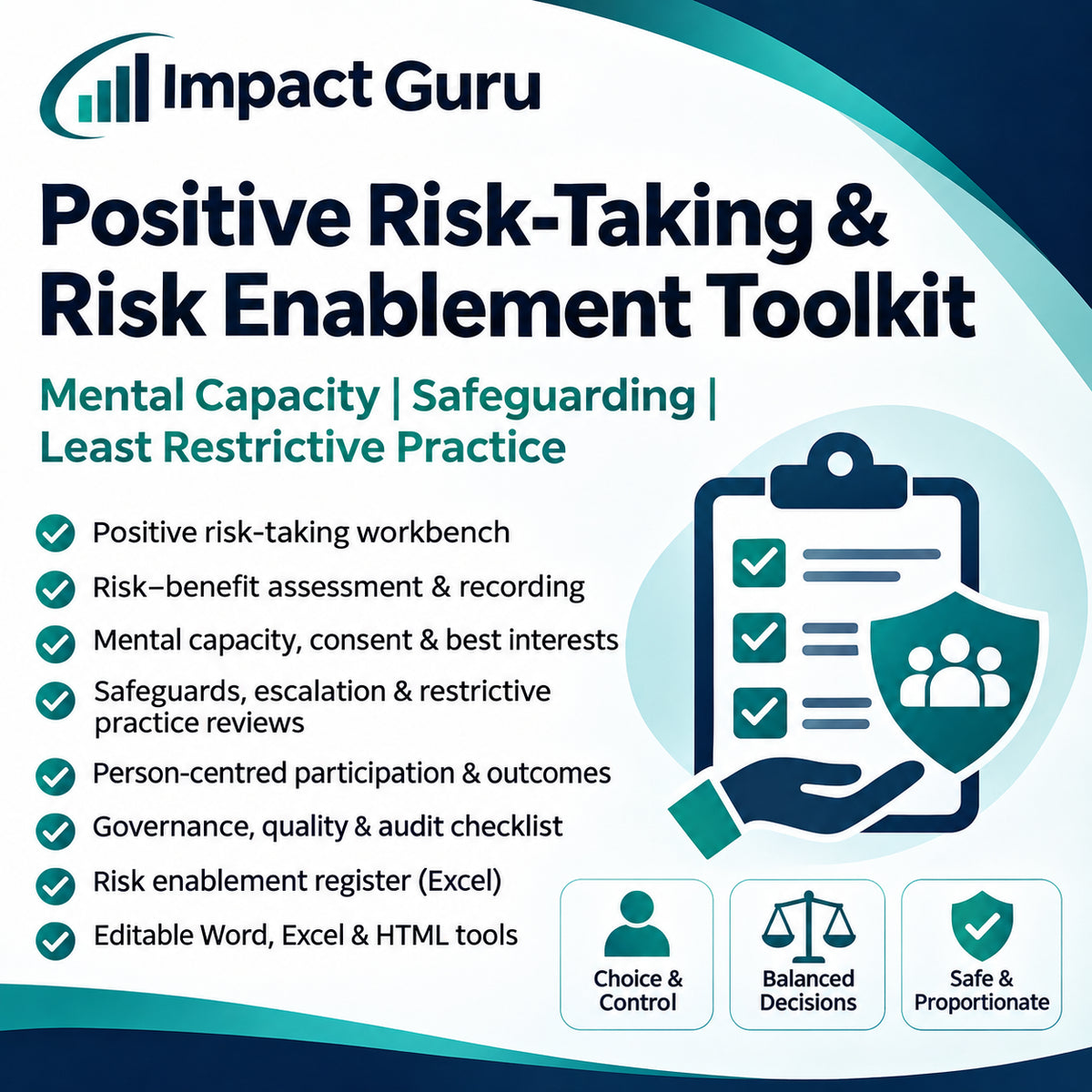
Positive Risk-Taking & Risk Enablement Toolkit | Mental Capacity, Safeguarding & Least-Restrictive Practice
Positive Risk-Taking & Risk Enablement Toolkit | Mental Capacity, Safeguarding & Least-Restrictive Practice
Couldn't load pickup availability
Positive Risk-Taking & Risk Enablement Toolkit — Version 1.0
A practical, self-configurable positive risk-taking, person-centred decision-making, safeguarding, least-restrictive practice and risk enablement assurance toolkit for adult social care providers in England.
Supporting people to make meaningful choices, develop independence and participate in everyday life requires more than identifying potential hazards. Providers must balance the benefits of enabling opportunities with foreseeable risks, appropriate safeguards, individual rights and their responsibilities for safe, lawful and accountable care.
Overly restrictive approaches can undermine independence, dignity, relationships and quality of life. Equally, poorly documented risk-taking decisions can expose people to avoidable harm, leave staff uncertain about their responsibilities and create difficulties when decisions are reviewed following incidents, safeguarding concerns or regulatory scrutiny.
The Impact Guru Positive Risk-Taking & Risk Enablement Toolkit — Version 1.0 has been developed to help organisations establish a more consistent, person-centred and evidence-led approach to making, implementing, recording and reviewing positive risk-taking decisions.
The toolkit combines an interactive risk enablement workbench, structured risk-benefit assessment, decision-specific mental capacity and consent recording, safeguarding and restriction review, person-centred outcome monitoring, governance assurance and a multi-worksheet risk enablement register.
It brings together an interactive offline HTML/JavaScript resource, editable Microsoft Excel recording and monitoring tools, and professionally formatted Microsoft Word documents.
These resources help organisations connect individual wishes, decision-making rights, potential benefits, foreseeable harm, proportionate safeguards, management accountability and evidence of outcomes within a repeatable risk enablement process.
The toolkit is designed for practical use in support planning, risk reviews, multidisciplinary discussions, management supervision, quality assurance, safeguarding governance and ongoing reviews of restrictive practice.
What Can the Toolkit Help You Achieve?
The toolkit provides a structured framework for enabling positive choices while demonstrating how foreseeable risks have been considered, safeguards agreed and decisions reviewed.
- Strengthen person-centred decision-making: Record what the person wants to achieve, why the activity matters and how their preferences have informed the decision.
- Evaluate benefits alongside risks: Consider independence, autonomy, relationships, community participation and quality of life alongside foreseeable harm.
- Support mental capacity and consent processes: Record decision-specific considerations, communication support, consent and relevant assessment or best interests arrangements.
- Promote least-restrictive practice: Examine whether safeguards are necessary, proportionate and compatible with the person's rights.
- Strengthen safeguarding arrangements: Identify potential abuse, neglect, exploitation or other harm and document appropriate escalation arrangements.
- Clarify staff responsibilities: Record agreed support, monitoring requirements, escalation triggers and review responsibilities.
- Review restrictions: Document the rationale for restrictive measures and consider whether they can be reduced or removed.
- Improve decision records: Establish a clearer audit trail explaining what was considered, who contributed and why an approach was selected.
- Monitor outcomes: Review whether the person achieved their intended outcome and whether the safeguards remained effective and proportionate.
- Strengthen governance: Support management oversight, quality assurance, audit activity and learning from incidents or reviews.
- Maintain an organisational register: Track decisions, safeguards, actions, reviews and emerging issues across services.
- Support consistent practice: Provide reusable documentation for managers and staff involved in complex risk enablement decisions.
The emphasis is on moving from defensive risk avoidance or isolated risk assessments towards proportionate decision-making, practical safeguards, measurable outcomes and accountable risk enablement.
What's Included in Your Download?
Version 1.0 is supplied as a single downloadable ZIP archive containing eight professional toolkit files.
The package includes:
- One User Guide & Implementation Manual in Microsoft Word format.
- One interactive HTML/JavaScript Positive Risk-Taking & Risk Enablement Workbench.
- One editable Risk–Benefit and Decision Record in Microsoft Word format.
- One editable Mental Capacity, Consent & Best Interests Record in Microsoft Word format.
- One editable Safeguards, Escalation & Restriction Review in Microsoft Word format.
- One editable Person-Centred Participation & Outcome Review in Microsoft Word format.
- One editable Governance, Quality & Audit Checklist in Microsoft Word format.
- One Microsoft Excel Risk Enablement Register & Action Trackers workbook containing six worksheets.
The files are numbered in their recommended order of use. Together, they provide a connected framework for planning, documenting, implementing, monitoring and reviewing positive risk-taking decisions.
1. User Guide & Implementation Manual
A professionally formatted Microsoft Word guide explaining the toolkit's purpose, structure, recommended operating arrangements and practical limitations.
The guide explains how the interactive workbench, Word records and Excel workbook can be used together to establish a consistent risk enablement process.
It supports users in understanding:
- The purpose and relationship of the eight toolkit components.
- How to establish an appropriate assessment and decision-making scope.
- The distinction between identifying risk and enabling proportionate opportunities.
- How to document the person's wishes and desired outcomes.
- When decision-specific mental capacity and consent considerations may be required.
- How to assess potential benefits and foreseeable harms.
- How to record safeguards, restrictions and escalation arrangements.
- How to allocate responsibilities and establish review dates.
- How to maintain evidence and management assurance.
- How to protect personal information and manage local working files.
- How to integrate toolkit outputs into existing support planning and governance processes.
The User Guide & Implementation Manual is File 01 and should be read before using the remaining components.
2. Interactive Positive Risk-Taking & Risk Enablement Workbench
An interactive HTML/JavaScript workbench that can be opened locally in a compatible modern desktop browser.
The workbench provides a structured environment for examining a proposed activity or decision, recording the intended benefits, identifying foreseeable risks and considering appropriate safeguards.
Its purpose is to support a clear and consistent decision-making process, not to replace individual professional judgement or automatically authorise a particular course of action.
Key functions include:
- Recording the assessment context and proposed activity.
- Identifying the person's wishes, preferences and desired outcomes.
- Considering benefits relating to independence, autonomy and participation.
- Identifying foreseeable harm and relevant safeguarding considerations.
- Recording mental capacity and consent considerations.
- Comparing alternative approaches and proportionate safeguards.
- Documenting responsibilities, escalation arrangements and review requirements.
- Preparing a structured risk enablement decision record.
- Producing a printable report for review and local retention.
The workbench is intended to complement the detailed Word records and Excel monitoring workbook.
Important: The workbench provides structured decision-support prompts. It does not make legal determinations, conduct a formal Mental Capacity Act assessment, authorise restrictive interventions or independently establish whether an activity is safe.
3. Risk–Benefit and Decision Record
An editable Microsoft Word document for documenting the rationale behind an individual positive risk-taking decision.
The record supports a balanced examination of:
- The proposed activity, choice or opportunity.
- The person's wishes and intended outcomes.
- Potential benefits for independence, wellbeing and participation.
- Foreseeable risks and possible consequences.
- Available alternatives and less restrictive approaches.
- Existing and proposed safeguards.
- Views and advice obtained from relevant people or professionals.
- The agreed decision and supporting rationale.
- Responsibilities, implementation arrangements and review dates.
The document helps managers demonstrate why an approach was selected, rather than recording only the presence of risk.
4. Mental Capacity, Consent & Best Interests Record
An editable Microsoft Word record supporting structured consideration of decision-specific mental capacity, consent, communication assistance and relevant best interests processes.
It provides recording sections for:
- The specific decision under consideration.
- Relevant communication and decision-making support.
- Capacity-related observations and evidence.
- Whether a formal decision-specific assessment is required or has been completed.
- Consent and the person's expressed preferences.
- Relevant consultation and advocacy arrangements.
- Best interests considerations where applicable.
- Less restrictive alternatives.
- Decision rationale, responsibility and review arrangements.
Important: This document is a supporting record and does not replace a legally compliant capacity assessment, best interests decision or any required authorisation.
5. Safeguards, Escalation & Restriction Review
A professionally formatted Microsoft Word document for recording how foreseeable harm will be managed without unnecessarily limiting the person's choices or rights.
The document supports:
- Identification of current and proposed safeguards.
- Clarification of staff support and monitoring arrangements.
- Identification of warning signs and escalation triggers.
- Recording safeguarding concerns and referral considerations.
- Review of restrictions and their stated purpose.
- Consideration of proportionality and less restrictive alternatives.
- Allocation of action owners and review dates.
- Documentation of changes following incidents or new evidence.
- Management oversight of significant or continuing restrictions.
The aim is to make safeguards practical, understandable and reviewable, rather than allowing restrictions to become permanent through routine practice.
6. Person-Centred Participation & Outcome Review
An editable Microsoft Word document designed to evaluate whether a positive risk-taking decision has achieved meaningful outcomes for the person.
It supports recording of:
- The person's original goals and preferences.
- The activity or opportunity undertaken.
- Participation, independence and personal outcomes.
- The person's experience and feedback.
- Whether agreed safeguards worked as intended.
- Any incidents, unexpected consequences or emerging risks.
- Changes in confidence, choice or quality of life.
- Whether restrictions can be reduced or removed.
- Actions required following the review.
- Responsibility and the next review date.
This component helps organisations demonstrate that positive risk-taking is assessed through real outcomes for people, rather than simply through completed paperwork.
7. Governance, Quality & Audit Checklist
A Microsoft Word checklist designed to support Registered Managers, quality leads and senior operational managers in reviewing the completeness, consistency and quality of risk enablement documentation.
The checklist considers:
- Whether the person's wishes and preferences are clearly recorded.
- Whether the potential benefits of the decision have been considered.
- Whether foreseeable harm has been identified and assessed.
- Whether capacity and consent arrangements have been addressed appropriately.
- Whether safeguards are clear, practical and proportionate.
- Whether restrictions have an appropriate rationale and review process.
- Whether safeguarding concerns have been escalated appropriately.
- Whether relevant professionals or advocates have been involved.
- Whether responsibilities and review dates are documented.
- Whether outcomes and learning have been evaluated.
- Whether identified gaps require management action.
The checklist supports structured internal quality assurance and helps identify areas where further evidence or review is needed.
8. Risk Enablement Register & Action Trackers
An editable Microsoft Excel workbook containing six worksheets for maintaining organisational records of positive risk-taking decisions, safeguards, reviews and improvement activity.
The workbook provides structured tables for recording and monitoring information across relevant services or operational teams.
It can support:
- Registration of positive risk-taking decisions and assessments.
- Monitoring of foreseeable risks and agreed safeguards.
- Recording of actions, owners, timescales and progress.
- Tracking of restriction reviews and required changes.
- Monitoring of person-centred outcomes and review findings.
- Recording of governance, quality assurance and follow-up activity.
The workbook is designed to support repeated management reviews and maintain an accessible overview of outstanding actions and assurance requirements.
All Excel recording tables use visible cell borders and structured headings to support practical completion and review.
The Word documents also include bordered tables and interactive checkbox controls intended for use in compatible Microsoft Word desktop applications.
Positive Risk-Taking: Balancing Choice, Rights and Safety
Positive risk-taking does not mean ignoring foreseeable harm, reducing safeguarding standards or encouraging people to undertake activities without appropriate support.
It means recognising that people have rights, preferences and ambitions, and that avoiding every possible risk may itself create disadvantages.
For example, a person receiving supported living services may wish to travel independently, manage their own spending, establish a new relationship or participate in community activities without continuous staff supervision.
Each situation may involve genuine risks. However, an automatic decision to prevent the activity could also limit independence, privacy, confidence and social participation.
A proportionate approach considers:
- What the person wants to achieve and why it matters.
- What benefits the activity may provide.
- What foreseeable harms could arise.
- How likely and serious those harms may be.
- What support or safeguards could reduce the risk.
- Whether the person can make the relevant decision with appropriate support.
- Whether any proposed restriction is necessary and lawful.
- How the arrangement will be reviewed and adjusted.
The toolkit helps organisations record this reasoning consistently while keeping the person's wishes and outcomes central.
Mental Capacity, Consent and Supported Decision-Making
In England, the Mental Capacity Act 2005 establishes important principles for decisions involving adults who may lack capacity to make a particular decision.
Capacity is decision-specific and time-specific. A person must not be treated as unable to make a decision merely because they make a choice that others consider unwise.
People should be supported to make their own decisions wherever practicable.
Where a person lacks capacity for a particular decision, any decision made on their behalf must follow the applicable legal framework, including relevant best interests requirements and consideration of less restrictive alternatives.
The toolkit encourages users to document:
- The precise decision under consideration.
- How the person has been supported to understand and communicate their wishes.
- What evidence is available regarding decision-making capacity.
- Whether a formal assessment or specialist advice is required.
- How consent has been addressed.
- What consultation or advocacy arrangements are relevant.
- Why the proposed approach is considered appropriate.
- How and when the decision will be reviewed.
The toolkit does not determine capacity automatically or substitute for formal legal processes.
Safeguarding and Least-Restrictive Practice
Risk enablement and safeguarding should operate together, not as competing priorities.
Effective safeguarding considers the person's wishes and desired outcomes while responding appropriately to abuse, neglect, exploitation and other foreseeable harm.
Positive risk-taking must never be used to justify avoidable harm, neglect, unsafe practice or failure to act on safeguarding concerns.
Similarly, safeguarding concerns do not automatically justify blanket restrictions on a person's independence or participation.
The toolkit supports structured consideration of:
- The nature and seriousness of foreseeable harm.
- Potential safeguarding concerns and immediate protection needs.
- The person's wishes and consent.
- Relevant capacity and legal considerations.
- Available safeguards and alternative approaches.
- Proportionality and the need for restrictions.
- Escalation, management oversight and review arrangements.
Where a decision involves serious or immediate harm, potential deprivation of liberty, significant restrictions, abuse or complex legal questions, appropriate professional, safeguarding or legal advice must be obtained through established procedures.
From Individual Decisions to Organisational Governance
Positive risk-taking is often discussed as an individual support-planning activity. However, providers also need organisational arrangements that ensure decisions are consistently documented, implemented and reviewed.
Senior leaders and managers should be able to understand:
- Whether people are being supported to exercise meaningful choice.
- Whether risks and benefits are considered together.
- Whether staff understand the rationale behind agreed safeguards.
- Whether capacity and consent requirements are addressed appropriately.
- Whether restrictions are reviewed rather than maintained indefinitely.
- Whether safeguarding concerns are identified and escalated.
- Whether incidents and complaints lead to appropriate learning.
- Whether decisions are reviewed when circumstances change.
- Whether positive risk-taking produces meaningful outcomes for people.
The toolkit's governance checklist and Excel register help organisations connect individual decision records with management oversight and quality improvement.
These resources can support supervision, service-level audits, quality meetings, provider governance and appropriate commissioner assurance discussions.
They do not replace mandatory regulatory reporting, safeguarding referrals or organisation-specific governance procedures.
Who Is This Toolkit For?
The Positive Risk-Taking & Risk Enablement Toolkit is designed for professionals involved in person-centred support, risk assessment, safeguarding, operational management and quality assurance.
- Registered Managers and service managers.
- Adult social care provider directors and senior leaders.
- Supported living managers and team leaders.
- Learning disability and autism service professionals.
- Mental health and complex care service managers.
- Homecare and community support managers.
- Positive Behaviour Support practitioners and leads.
- Safeguarding leads and designated safeguarding professionals.
- Care coordinators and support planning professionals.
- Quality assurance and compliance leads.
- Operations and regional managers.
- Responsible Individuals and provider governance teams.
- Commissioners and contract monitoring professionals.
- Independent health and social care consultants.
The toolkit is particularly relevant where providers support people to exercise independence, make complex decisions, manage personal risks or participate in activities that may involve uncertainty.
How the Toolkit Works
Step 1 — Read the User Guide
Begin with File 01 to understand the toolkit's components, recommended workflow, limitations and information governance considerations.
Step 2 — Define the Decision and Desired Outcome
Use the interactive workbench to describe the proposed activity or choice, the person's wishes and the outcome they want to achieve.
Step 3 — Assess Benefits and Foreseeable Risks
Consider the positive outcomes associated with enabling the activity alongside potential harm, uncertainty and safeguarding concerns.
Step 4 — Record Capacity and Consent Considerations
Use the Mental Capacity, Consent & Best Interests Record to document relevant decision-making support, evidence, advice and lawful processes.
Step 5 — Agree Proportionate Safeguards
Use the Safeguards, Escalation & Restriction Review to record practical support arrangements, restrictions, escalation triggers and responsibilities.
Step 6 — Complete the Risk–Benefit Decision Record
Document the final decision, rationale, alternatives considered, safeguards and review arrangements.
Step 7 — Implement and Monitor the Plan
Use the Excel register and action trackers to maintain oversight of implementation, outstanding actions and scheduled reviews.
Step 8 — Review the Person's Outcomes
Use the Person-Centred Participation & Outcome Review to assess whether the activity supported the person's goals and whether the safeguards remained proportionate.
Step 9 — Complete Governance and Quality Assurance
Use the Governance, Quality & Audit Checklist to identify documentation gaps, review restrictions, confirm accountability and agree improvement actions.
Designed for Practical, Repeated Use
The toolkit is designed as a reusable professional management resource rather than a single risk assessment or static report.
The interactive workbench operates locally in a compatible browser, while the Excel workbook and Word documents can be edited and adapted to organisational requirements.
Professionally formatted tables, visible borders, structured recording fields and interactive Word checkbox controls support practical completion and management review.
Core offline use does not require a separate Impact Guru application account or ongoing subscription.
Important: Positive risk-taking records may contain sensitive personal information. Users must maintain appropriate confidentiality, secure storage, access controls, retention arrangements and compliance with applicable data protection requirements.
Where possible, use anonymised identifiers during initial planning and avoid placing unnecessary identifiable information into working copies.
Free Positive Risk-Taking Planner or Professional Toolkit?
Impact Guru also provides a free online Positive Risk-Taking Planner that helps adult social care providers consider individual risk enablement decisions and generate an initial person-centred plan.
The free resource introduces relevant considerations around capacity, safeguarding, autonomy, least-restrictive practice, foreseeable risks and suggested safeguards.
It is designed to help managers and practitioners begin a structured discussion about a particular decision.
The downloadable Positive Risk-Taking & Risk Enablement Toolkit serves a broader operational purpose.
It provides an offline decision-support workbench, editable risk-benefit and capacity records, detailed safeguarding and restriction review documents, person-centred outcome monitoring, governance audit resources and a multi-worksheet Excel register.
It supports implementation, ongoing review and organisational assurance rather than relying solely on a single online plan.
The free resource helps users identify the main considerations surrounding a positive risk-taking decision. The professional toolkit provides the working documents and monitoring resources needed to record the decision, agree safeguards, review outcomes and demonstrate accountable risk enablement over time.
Download Format and Technical Requirements
- Delivery: Digital download supplied as a ZIP archive.
- Version: 1.0.
- Package: Eight professional files.
- File 01: User Guide & Implementation Manual — editable DOCX.
- File 02: Positive Risk-Taking & Risk Enablement Workbench — offline HTML/JavaScript.
- File 03: Risk–Benefit and Decision Record — editable DOCX.
- File 04: Mental Capacity, Consent & Best Interests Record — editable DOCX.
- File 05: Safeguards, Escalation & Restriction Review — editable DOCX.
- File 06: Person-Centred Participation & Outcome Review — editable DOCX.
- File 07: Governance, Quality & Audit Checklist — editable DOCX.
- File 08: Risk Enablement Register & Action Trackers — editable XLSX with six worksheets.
- Internet connection: Not required for core offline workbench and document-editing functions.
- Account: No separate Impact Guru application account required.
- Recommended environment: Desktop or laptop computer with compatible Microsoft Office applications and a modern web browser.
- Word checkboxes: Interactive checkbox content controls intended for compatible Microsoft Word desktop applications.
- PDF reporting: Printable workbench reports can be saved as PDF documents using the browser's print function.
- Data responsibility: Users are responsible for validating records, protecting personal information and maintaining secure local storage.
- Updates: The toolkit does not automatically retrieve legislative, regulatory or safeguarding guidance changes.
This is a downloadable professional risk enablement toolkit, not a hosted care management system, automated safeguarding decision-maker, legal advisory service or bespoke consultancy engagement.
About Impact Guru
Impact Guru provides specialist bid strategy, tender writing, quality assurance and professional intelligence resources for organisations operating across adult social care and related public service sectors.
The Positive Risk-Taking & Risk Enablement Toolkit reflects an evidence-led approach to person-centred practice, independence, safeguarding, proportionate risk management and organisational accountability.
It has been developed to help providers connect individual choice with practical support arrangements, effective governance and meaningful outcomes.
Important Professional, Safeguarding, Legal and Technical Disclaimer
The Positive Risk-Taking & Risk Enablement Toolkit is an independent professional management resource developed by Impact Guru Ltd.
It provides structured decision-support, risk-benefit assessment, recording, monitoring and governance assurance resources.
The toolkit does not independently determine whether a person has mental capacity, establish legal consent, authorise restrictions, determine whether deprivation of liberty safeguards or other legal authorisation are required, or guarantee that a proposed activity is safe.
It does not replace the Mental Capacity Act 2005, the Care Act 2014, applicable human rights requirements, safeguarding duties, CQC regulatory requirements, professional standards, commissioner specifications, organisational policies or appropriate clinical and legal advice.
Any suggested assessment prompts, scores, decision-support outputs or recommendations are indicative and must be considered against the person's circumstances, reliable evidence, current law and professional judgement.
Users must independently verify information, assess the suitability of safeguards, document lawful decision-making and obtain appropriate specialist advice where necessary.
Where immediate safeguarding concerns, serious harm, abuse, neglect or unlawful restrictions are suspected, organisations must follow established safeguarding, emergency, management and legal escalation procedures without waiting for completion of the toolkit.
Users are responsible for complying with applicable UK GDPR, Data Protection Act 2018 and organisational information governance requirements when processing personal information.
The toolkit does not automatically update when legislation, regulatory guidance, safeguarding requirements or commissioner expectations change.
Digital product: Please review the product description, technical requirements and applicable digital-product terms before purchasing.
Share