Impact Guru
CQC Evidence Assurance Toolkit | Inspection Readiness, Governance & Quality Improvement
CQC Evidence Assurance Toolkit | Inspection Readiness, Governance & Quality Improvement
Couldn't load pickup availability
CQC Evidence Assurance Toolkit — Version 1.2
Regulatory Transition Edition: a practical, self-configurable evidence assurance, inspection-readiness and regulatory change-management toolkit for adult social care providers in England.
Being prepared for CQC assessment involves more than maintaining policies, completing audits and recording staff training. Providers need to demonstrate that their evidence is current, reliable and connected to what actually happens in practice. They also need to show how concerns are identified, escalated, addressed and reviewed through effective governance arrangements.
With CQC reviewing its assessment methodology following the 2026 pilot programme, providers also face an additional challenge: maintaining assurance against current regulatory requirements while preparing for possible changes to assessment frameworks, inspection questions and rating methodology.
The Impact Guru CQC Evidence Assurance Toolkit — Version 1.2 has been developed to help Registered Managers, quality and compliance leads, operational managers and provider directors take a structured, evidence-led approach to understanding their organisation's assurance position.
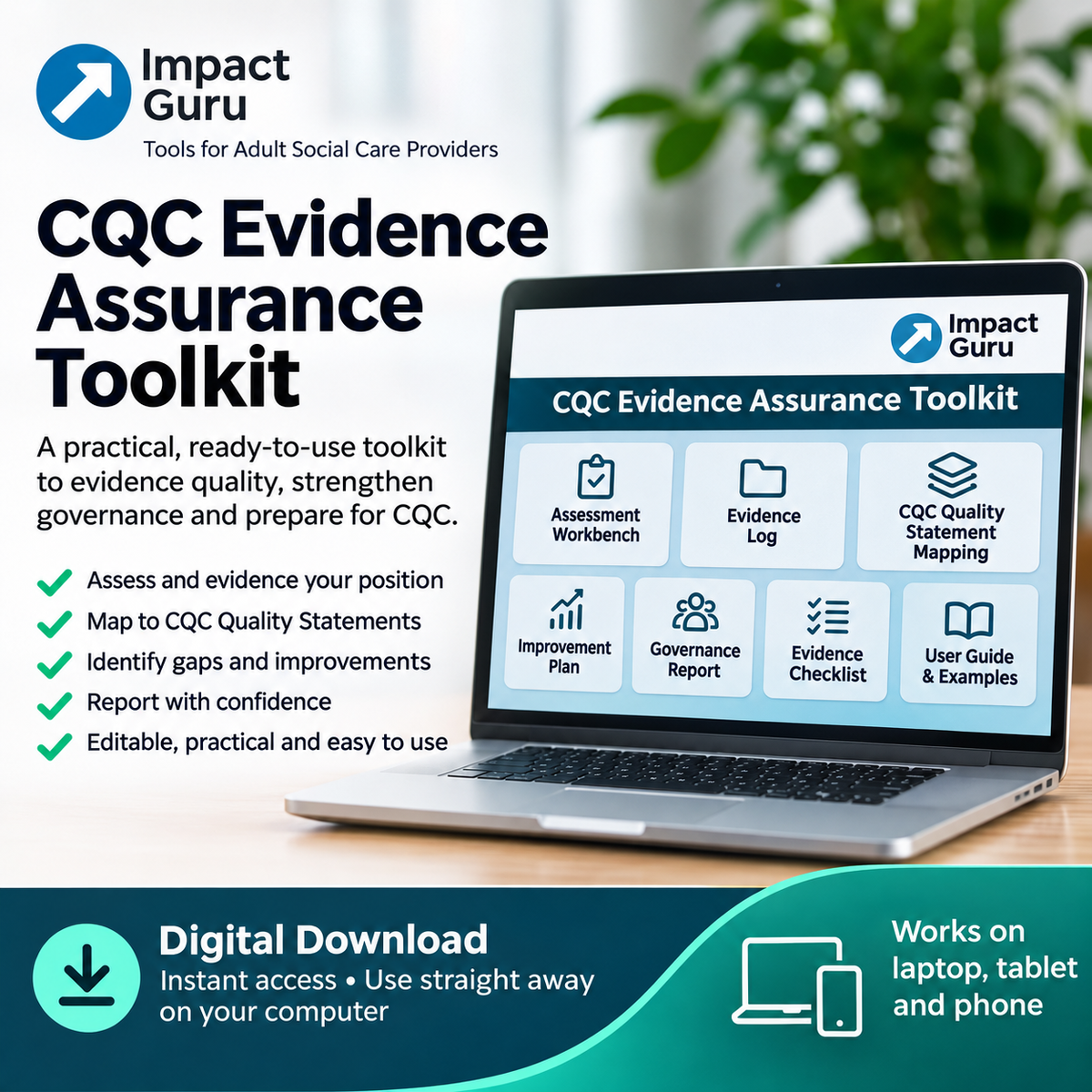
Combining an interactive assessment workbench with professionally formatted, editable Word templates, the toolkit supports evidence review, improvement planning, regulatory mapping, management oversight, evidence triangulation and preparation for inspection or commissioner assurance activity.
Version 1.2 introduces professionally redesigned supporting documents and a practical worked example, building on the regulatory transition and change-control functionality introduced in Version 1.1.
The supporting templates now feature consistent Impact Guru branding, structured assessment tables, practical checklists, editable response fields and management review sections where appropriate.
It is designed as a reusable working resource, helping organisations move beyond identifying potential gaps towards documenting evidence, assigning responsibilities, validating improvement and maintaining effective oversight.
What Can the Toolkit Help You Achieve?
The toolkit provides a practical framework for reviewing whether your organisation can demonstrate the quality, safety and effectiveness of its services through credible, appropriately validated evidence.
- Identify evidence weaknesses: Review the availability, quality and reliability of evidence across important care, safety and governance themes.
- Assess assurance confidence: Record internal evidence ratings and identify areas requiring further investigation or validation.
- Prioritise improvement: Distinguish between routine development needs and issues requiring more urgent management attention.
- Strengthen evidence triangulation: Compare records, observations, feedback, outcomes and management information to test whether findings are reliable.
- Manage regulatory transition: Record applicable assessment arrangements, monitor proposed changes and document organisational decisions about implementation.
- Strengthen governance: Document findings, action ownership, review arrangements and leadership oversight.
- Prepare for CQC scrutiny: Organise evidence and develop clearer explanations of how practice is monitored and improved.
- Verify improvement: Review whether corrective actions have changed practice, reduced risk and produced sustained benefits.
- Understand the complete assurance process: Follow a fictional supported living worked example demonstrating how evidence findings progress through improvement planning, management oversight and closure verification.
The emphasis is on strengthening the connection between evidence, professional judgement, regulatory awareness, management accountability and demonstrable improvement.
What's Included in Your Download?
Version 1.2 is supplied as a single downloadable ZIP archive containing 12 customer-facing files.
The package includes:
- One interactive HTML evidence assurance workbench.
- Eight professionally formatted, editable Microsoft Word templates and guides.
- One PDF quick-start guide.
- One additional fictional supported living worked example in Microsoft Word format.
- One customer README explaining the package structure and where to begin.
The worked example is stored separately within an Examples folder to distinguish illustrative material from the blank templates intended for organisational use.
1. Interactive CQC Evidence Assurance Workbench
The central component is an interactive HTML application that can be opened locally in a compatible desktop web browser.
The workbench provides a structured assessment environment covering 12 assurance themes, with facilities for recording evidence assessments, reviewing priorities and documenting improvement actions.
Version 1.2 retains the established assessment functionality and regulatory transition information introduced in Version 1.1.
Key capabilities include:
- Structured assessment across 12 evidence and assurance themes.
- Internal evidence ratings and identification of potential weaknesses.
- Risk prioritisation and improvement action tracking.
- Configurable assessment framework information.
- Recording of regulatory guidance review dates and responsibilities.
- Local JSON backup and import functionality.
- CSV export for further analysis or reporting.
- Printable assessment reports.
The workbench is intended to support professional assessment rather than replace it. Internal ratings are management indicators and must not be interpreted as official CQC scores, ratings or predictions of inspection outcomes.
2. Evidence Inventory & Sampling Plan
A professionally formatted, editable Word template for organising available evidence, identifying relevant records and planning proportionate sampling activity.
Structured tables and assessment fields support systematic evidence collection and review, including the identification of missing, incomplete, outdated or insufficiently validated material.
The template places particular emphasis on evidence confidence and selecting records that provide a meaningful picture of service quality.
3. CQC Quality Statement Mapping Workbook
An editable Word template for connecting service evidence and assurance findings to relevant CQC quality statements under the applicable assessment arrangements.
Structured mapping fields support the recording of evidence references, findings and areas requiring further assurance.
The template also supports alternative or future framework references, helping organisations prepare for possible changes to sector-specific assessment questions.
Users should maintain alignment with the CQC assessment guidance currently applicable to their services and update their mapping only when changes are officially confirmed.
4. 90-Day Improvement & CAPA Plan
A structured improvement-planning template covering corrective and preventive action, accountability, implementation, review and follow-up.
Editable tables support the recording of findings, action owners, target dates, progress, supporting evidence and verification arrangements.
The template encourages users to consider whether the underlying problem has been addressed and whether improvement can be demonstrated, rather than simply recording that an action has been completed.
5. Board & Provider Assurance Report
A professionally formatted reporting framework for presenting quality, safety, governance and improvement findings to senior leaders, provider representatives or board-level oversight arrangements.
Structured reporting sections support executive summaries, assurance findings, unresolved risks, management decisions and follow-up actions.
The report encourages leadership teams to examine the effectiveness of improvement actions rather than relying solely on audit completion figures or administrative progress measures.
6. Inspection Challenge & Staff Briefing
A practical preparation resource to help managers and teams consider how they would explain their service's systems, decisions and evidence during inspection or assurance discussions.
Structured prompts and checklists support constructive internal challenge, staff preparation and a more consistent understanding of how governance arrangements operate in practice.
The resource can also help teams distinguish current inspection expectations from proposed changes to CQC's assessment methodology.
7. Configuration & User Guide
A detailed, professionally formatted guide explaining how to use the toolkit, interpret its assessment approach, manage working files and understand its limitations.
The Version 1.2 guide includes additional instructions explaining the new worked example, its separate folder location and how it can be used to understand the relationship between assessment findings, improvement actions and assurance reporting.
It also retains guidance on regulatory transition, framework configuration, evidence confidence and the distinction between internal assurance assessments and official regulatory judgements.
8. Regulatory Transition & Change Control
Introduced in Version 1.1 and retained in Version 1.2.
An editable regulatory change-control resource designed to help organisations monitor developments in CQC assessment arrangements and manage their response systematically.
It supports the recording of:
- Current requirements and proposed regulatory developments.
- Official guidance sources and review dates.
- Potential implications for service-level evidence and assurance.
- Responsible managers and implementation decisions.
- Actions required following confirmed changes.
- Review arrangements and change-control records.
The resource is intended to help prevent premature changes to quality systems while ensuring that confirmed developments are considered and implemented appropriately.
9. Evidence Triangulation & Closure Test
Introduced in Version 1.1 and retained in Version 1.2.
An editable template for testing whether assurance findings are supported by reliable evidence and whether completed improvement actions have achieved their intended effect.
Structured review fields encourage users to compare different evidence sources, consider inconsistencies and document the rationale for management conclusions.
It also supports follow-up review of corrective actions, helping organisations distinguish between administrative action closure and verified improvement in practice.
10. Quick Start Guide
A PDF introduction to help users begin working with the toolkit, understand the principal components and follow a practical sequence for completing their first evidence assurance review.
The Version 1.2 guide references the expanded supporting documentation and the new worked example.
11. Worked Example — Fictional Supported Living Provider
New in Version 1.2.
A professionally formatted, three-page worked example demonstrating how a fictional supported living provider can use the toolkit to identify an evidence weakness, plan corrective action and verify improvement.
The scenario focuses on inconsistent evidence of staff competency and shows how an initial assurance concern can progress through a structured management review process.
The example illustrates:
- Identifying an evidence gap during an initial assessment.
- Reviewing and sampling supporting records.
- Considering the implications for assurance confidence and service quality.
- Recording corrective actions and assigning management responsibilities.
- Establishing review and verification arrangements.
- Documenting management oversight.
- Testing whether corrective actions have produced meaningful improvements.
- Recording the final assurance position and any outstanding concerns.
The worked example is provided for learning and illustration only. It uses fictional information and should not be treated as evidence of an actual provider's regulatory compliance or inspection readiness.
The example is supplied in a separate Examples folder so purchasers can clearly distinguish completed illustrative material from the blank templates intended for their own assessments.
12. Customer README & Package Instructions
A short introductory file explaining the contents of the download, the recommended starting point and the location of the worked example.
It helps users understand the package structure before beginning their first assessment.
Designed for CQC Regulatory Transition
CQC has been reviewing its assessment methodology, including proposals concerning sector-specific assessment frameworks, structured key lines of enquiry, rating characteristics and scoring arrangements.
These developments may affect how providers organise and explain their evidence, but proposed reforms should not be treated as implemented regulatory requirements.
The toolkit is designed to support a controlled transition rather than assume that one future assessment model has already been adopted.
Its approach separates the enduring foundations of provider assurance — safe care, person-centred practice, safeguarding, workforce competence, governance and improvement — from assessment terminology and framework references that may change.
This allows organisations to maintain evidence against current requirements while documenting developments that may require future changes.
The toolkit does not automatically update itself when CQC publishes new guidance. Users remain responsible for checking official regulatory publications and reviewing their own assurance arrangements.
Who Is This Toolkit For?
The CQC Evidence Assurance Toolkit is designed for professionals responsible for service quality, regulatory compliance, operational assurance and organisational improvement.
- Registered Managers and Nominated Individuals.
- Adult social care provider directors and senior leaders.
- Quality assurance and compliance managers.
- Operations and regional managers.
- Safeguarding and governance leads.
- Internal auditors and quality improvement teams.
- Independent adult social care consultants.
It may be relevant to organisations delivering homecare, supported living, learning disability and autism support, mental health services, complex care, residential care and other CQC-regulated adult social care services in England.
Users should adapt the toolkit to their specific regulated activities, service models, organisational responsibilities and applicable requirements.
How the Toolkit Works
Step 1 — Establish Your Evidence Position
Open the interactive workbench and review the assurance themes relevant to your service. Consider what evidence is available, whether it is sufficiently current and reliable, and what it demonstrates about actual practice.
Step 2 — Identify and Prioritise Weaknesses
Use the assessment structure to identify areas where evidence is missing, incomplete, inconsistent or insufficiently validated. Consider the implications for safety, quality, governance and management assurance.
Step 3 — Test Evidence Reliability
Use the evidence inventory and triangulation resources to compare relevant records, observations, feedback, outcomes and management information.
Consider whether different evidence sources support the same conclusion and whether apparent strengths or weaknesses require further investigation.
Step 4 — Develop and Verify Improvement Actions
Use the 90-Day Improvement & CAPA Plan to document findings, establish action ownership and determine how improvements will be implemented, reviewed and validated.
Apply the closure-testing resource to examine whether actions have changed practice and whether improvements have been sustained.
Step 5 — Strengthen Leadership Oversight
Translate assessment findings into management and provider assurance reporting, including unresolved concerns, emerging themes, progress against actions and evidence requiring further challenge.
Step 6 — Monitor Regulatory Developments
Use the Regulatory Transition & Change Control resource to record relevant CQC developments, distinguish proposals from confirmed requirements and assign responsibility for any necessary changes.
Step 7 — Review Progress and Maintain Assurance
Repeat the assessment as appropriate, retain working records and use follow-up evidence to determine whether changes have improved practice and strengthened organisational assurance.
Step 8 — Use the Worked Example for Guidance
Before completing the templates for a live service, review the fictional supported living example supplied in the separate Examples folder.
The example demonstrates how the toolkit's assessment, evidence review, corrective action and management assurance components can work together.
Use it to understand the intended workflow, then complete your own assessment using verified organisational evidence and professional judgement.
From Evidence Collection to Demonstrable Improvement
A common weakness in quality assurance systems is the gap between identifying a problem and demonstrating that the organisation has resolved it effectively.
An audit may identify an incomplete risk assessment. A management meeting may allocate an action. A subsequent report may record that the action has been completed.
However, meaningful assurance requires further questions. Was the underlying problem understood? Were similar records reviewed? Did staff practice change? Was the improvement sustained? Can leaders demonstrate that the risk has been reduced?
The Version 1.2 toolkit supports the following evidence chain:
Evidence review → Gap identification → Evidence triangulation → Risk prioritisation → Corrective action → Management oversight → Improvement verification → Ongoing assurance.
The triangulation and closure-testing resources help organisations examine whether their conclusions are sufficiently supported and whether completed actions have achieved meaningful improvements.
The new worked example demonstrates this process through a realistic fictional scenario, showing how individual assessment and reporting documents contribute to a connected assurance workflow.
This approach can support more credible internal assurance arrangements, clearer management reporting and better preparation for regulatory or commissioner scrutiny.
Designed for Practical, Repeated Use
Unlike a one-off assessment report, the CQC Evidence Assurance Toolkit provides reusable working resources that can support ongoing quality monitoring, regulatory awareness and improvement activity.
The interactive workbench operates locally in a compatible browser, without requiring a separate online account or ongoing subscription.
The accompanying editable Word documents can be adapted to reflect local service arrangements, reporting structures, regulated activities and organisational procedures.
The professionally formatted Version 1.2 templates include structured tables, practical checklists, document control fields and management reporting sections where appropriate.
Framework references can be reviewed as regulatory guidance develops, although users are responsible for validating changes and ensuring that their working documents remain accurate.
Important: Users are responsible for managing their working files, maintaining backups and protecting confidential or personal information. The toolkit is not a hosted case management system or secure evidence repository.
Free Resource or Professional Toolkit?
Impact Guru also provides a free online CQC Evidence Gap Analyzer, designed to support an initial, indicative review of inspection readiness, evidence weaknesses and suggested improvement priorities.
The downloadable CQC Evidence Assurance Toolkit serves a different purpose.
Rather than relying solely on a short self-assessment, it provides a structured working environment for examining evidence, recording assurance judgements, testing evidence reliability, planning improvements and preparing management reports.
Version 1.2 also includes professionally formatted assurance templates and a worked example, making it easier for organisations to understand how the different components contribute to a complete review and improvement process.
The free analyser is a useful starting point. The professional toolkit provides more extensive working resources for ongoing evidence assurance, governance and improvement.
Download Format and Technical Requirements
- Delivery: Digital download supplied as a ZIP archive.
- Version: 1.2 — Regulatory Transition Edition.
- Package: 12 customer-facing files, including a separate fictional worked example.
- Interactive application: HTML file for use in a compatible modern desktop browser.
- Editable templates: Microsoft Word DOCX format.
- Guidance: PDF, DOCX and customer README.
- Internet connection: Not required for the core offline workbench.
- Account: No separate Impact Guru application account required.
- Regulatory updates: The toolkit does not automatically retrieve or install changes to CQC guidance.
A desktop or laptop computer is recommended for the most practical experience when completing assessments, managing files and editing templates.
This is a downloadable professional toolkit, not a cloud-hosted software subscription, live regulatory monitoring service or bespoke consultancy engagement.
About Impact Guru
Impact Guru provides specialist bid strategy, tender writing, quality assurance and professional intelligence resources for organisations operating across adult social care and related public service sectors.
The CQC Evidence Assurance Toolkit reflects a practical approach to governance, evidence quality, regulatory awareness, operational accountability and continuous improvement.
Explore further guidance through the Impact Guru CQC Compliance Knowledge Hub.
Important Professional and Regulatory Disclaimer
The CQC Evidence Assurance Toolkit is an independent professional management and quality assurance resource developed by Impact Guru Ltd. It is not produced, approved, endorsed or accredited by the Care Quality Commission.
It does not provide an official CQC assessment, regulatory rating, certification of compliance or guarantee of inspection outcomes.
Assessment outputs are indicative and depend on the accuracy, completeness and professional interpretation of information entered by the user.
The toolkit includes resources for monitoring and responding to regulatory developments, but it does not automatically update when CQC changes its assessment methodology. It should not be interpreted as confirmation that proposed assessment reforms have been implemented.
Users must refer to current CQC guidance, applicable legislation, regulatory requirements and their own professional or legal advisers where appropriate. CQC assessment methods, guidance and operational arrangements may change over time.
The toolkit does not replace statutory duties, safeguarding procedures, professional judgement, independent audit or specialist advice.
Digital product: Please review the product description, technical requirements and applicable digital-product terms before purchasing.
Share